3. RMMV within the Financial Cooperation Project Cycle
This Section offers concrete practical advice to all Financial Cooperation (FC) project stakeholders for managing a FC project remotely. It describes the relevance of RMMV for each step along the FC project cycle and provides tangible recommendations on what needs to be considered during each step, as well as checklists, templates, and examples. KfW must adapt its own approaches and tool types to be able to conduct its crucial verification tasks (project appraisal; progress reviews, including verification of the use of funds; final reviews; and ex-post evaluation) despite limited access to project sites and target groups. It is important to note, however, that the recommendations of this Guidebook do not replace or change any official KfW procedures during the FC project cycle, but rather provide assistance to KfW and its implementing partners in how to execute these procedures in a remote modality.
Although this Guidebook refers to KfW's mode of operation, the principles can, of course, be transferred to the business models of other development stakeholders.
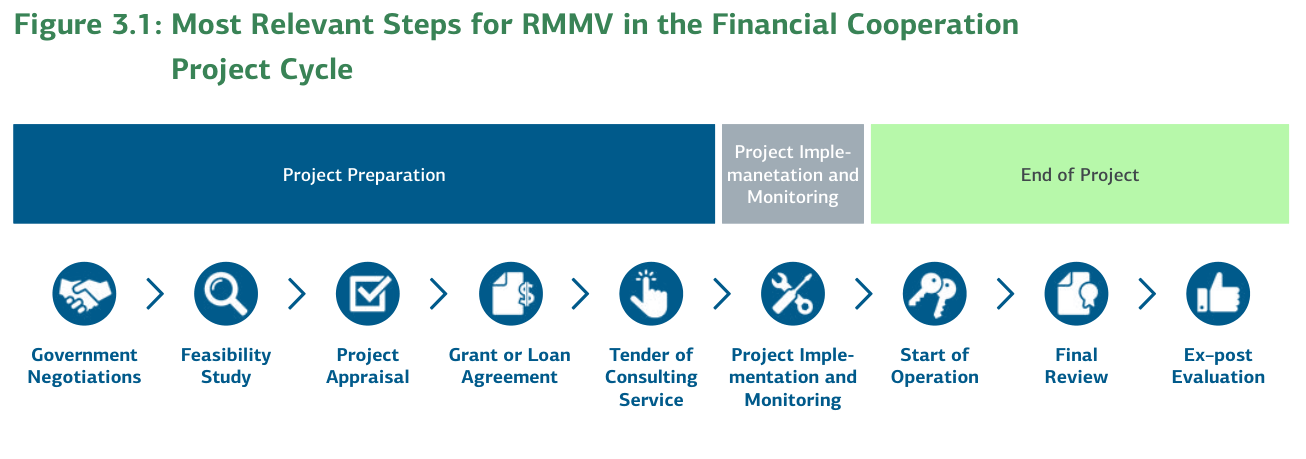
Figure 3.1: Most Relevant Steps for RMMV in the Financial Cooperation Project Cycle
3.1 Project Preparation
For KfW to fulfill its obligations stemming from the general contract with BMZ and the > General Guidelines for the German Technical and Financial Development Cooperation (only available in German) along the FC project cycle, the mix of RMMV approaches, technical tool types and data sources must be developed as early as possible in the project cycle, agreed with the implementing partners, and designed to suit the project stakeholders' needs. This Section outlines the key steps in project preparation and outlines central considerations around the integration of RMMV at this stage: This covers both the use of RMMV during project preparation in a situation with limited access to project sites and the design of the RMMV approach for project implementation that needs to be developed and agreed on during the project preparation phase.
3.1.1 Government Negotiations
The FC implemented by KfW is based on the country strategy of the Federal Ministry for Economic Cooperation and Development (BMZ) and the development strategies of the partner country. The projects and programs supported are proposed at bilateral government negotiations, and the German government decides up to what level funding is to be committed. An intergovernmental agreement is concluded on the sector and type of projects that are going to be supported. This first step in the project cycle is important for RMMV for the following reasons:
-
Government negotiations present an opportunity to define the (sub-)sectoral focus of the future financial engagement, > Section 3.1.1.1 below
-
They require preparatory work by KfW and the potential project partners in pre-assessing the feasibility of proposed project ideas within the defined (sub-)sector, so that non-feasible ideas can be dropped in time,
Section 3.1.1.2 further below.
- They present an opportunity to anchor the prerequisites for the mix of RMMV approaches for the proposed project idea early on, including particularly:
agreeing on granting KfW access to the relevant project data sources (e.g., to the project-related part of the PEA's management information system), > Section 2.2.3 Data Sources and > Fact Sheet (Remote) Management Information Systems protecting the interests of target groups and other stakeholders involved in RMMV where their data privacy and security or any other human rights aspects might be affected (e.g., by agreeing on a citizen feedback crowdsourcing mechanism as part of the project design), > Sections 2.3.1 on Data Protection & Privacy, > 2.3.2 on Information Security & Confidentiality and > 2.3.3 Human Rights Aspects enabling the use of intended RMMV technical tool types (e.g., UAVs/drones) via exemptions from respective laws or regulations, as necessary, > Sections 2.3.4 Rights of Use and Copyright and > 2.3.5. Country-specific Regulations.
3.1.1.1 Choice of Sector, Region, and Financing Instrument
Before and in parallel with government negotiations, KfW is requested by its German government clients to gain an overview of the (sub-)sector under discussion and to identify potential interventions based on the proposals submitted by the partner government. At this stage, KfW starts reviewing whether the proposed projects are developmentally sound and realizable. The choice of (sub-)sector depends on both countries' development strategies and policies, the core areas of intervention agreed upon between the German government and the respective partner country government, the needs and capacities of the prospective target groups, the capacity of the potential PEA and the evaluation of potential issues and risks.
With regards to RMMV, there are some sectors and financing instruments that are less affected by challenges and risks resulting from reduced site access because these largely rely on partners' systems and do not require any physical checks on project progress and use of funds, such as program-based approaches like policy-based lending or basket funds in the governance sector or financial sector support projects or (co-)financing of UN programs (they do however require other pre-conditions to be met). Most bilateral infrastructure or environment projects do require physical checks of at least a sample of (prospective) sites. The more complex a project is, the more challenging its remote implementation becomes. This needs to be considered when agreeing on the (sub-)sector and financing instrument > Section 3.1.1.2 below. Flexibility in choosing target regions for the intervention is especially important in fragile and conflict-affected environments, so that in case a proposed target region becomes inaccessible, another region can be selected instead. If the target region has been defined during government negotiations without alternatives or flexibility, adaptation strategies become difficult.
3.1.1.2 Pre-assessing the Feasibility of Proposed Project Ideas
Before the government negotiations take place, the project partners need to make sure that the sectoral and regional focus of an FC engagement and possible project ideas can realistically be implemented, if necessary through a mix of institutional RMMV approaches, technical tool types and data sources. While institutional RMMV approaches, technical tool types and data sources can go a long way in enabling KfW to finance projects in areas inaccessible to international staff, KfW may have to recommend its clients and partners to drop a project idea entirely from the list of projects before or during government negotiation in the following cases:
- Complex project ideas that require constant international staff presence or that have obvious high environmental and social risks, such as dam construction
- Projects for which sufficient environmental and social data to inform decision-making cannot be collected in a timely and/or reliable manner
- Project areas that are completely inaccessible most of the time to local project staff
- Project regions or areas where electronic data collection devices cannot be used
- Projects that require the direct involvement of target groups in RMMV that are being implemented in countries that have a significant lack of freedom of expression, because the social risk would be too high that an individual becomes negatively affected by his/her participation or feedback, which could, in addition, create unacceptably high reputational risks for KfW, > Sections 2.3.3 Human Rights Aspects, > 2.5 RMMV Decision Matrix and > 3.1.1.3 Environmental and Social Risks Categorization.
If one of the chosen RMMV approaches requires significant investment or requires the partner government to collect, share, publish or improve data or its own data systems (see also Case A mentioned in the > Fact Sheet (Remote) Management Information Systems), it is advisable to refer to the respective RMMV clauses to be agreed during project appraisal (> Section 3.1.3 Conducting Project Appraisals Remotely) and for this to be stated in the project's Grant or Loan or Separate Agreement (> Section 3.1.4 Contractual Considerations) and/ or in the respective consultant contract (> Section 3.1.5 RMMV Aspects in the ToR, Tendering and Contracting of Consulting Services) upfront in government negotiations, as this may affect the overall feasibility of the project idea. Partner governments may be hesitant to share their own data, publish critical information, or update their systems for various reasons. They may be concerned about criticism appearing online or may not prefer information of religious or ethnic composition to become publicly available. However, government willingness is crucial for some RMMV approaches, such as crowdsourcing tools that require an online platform where people can provide feedback or government-owned (Remote) Management Information Systems or Maintenance Management Systems where KfW requires access to partner country systems. If this is the case, a mix of institutional RMMV approaches, technical tool types and data sources should be discussed during government negotiations and recorded in the minutes of meeting to secure government buy-in early on. Mentioning planned institutional RMMV approaches, tool types and data sources during government negotiations demonstrates the transparency of the FC partners' objectives and outlines the government's responsibility for their appropriate uses. This creates mutual trust and allows BMZ and other KfW clients to officially address any upcoming RMMV issues in the future. This was for instance successfully done in the > Decentralization Support Program in Togo (PN: 30205), where a mobile crowdsourcing-based citizen feedback-loop system was introduced and already mentioned during government negotiations.
What to write in the Summary Records of the Government Negotiations If relevant, briefly mention the proposed mix of institutional RMMV approaches, tool types and data sources in the summary records and refer to the RMMV Guidebook published on KfW's website for further information. For example, "Creation of a monitoring system by citizens in selected towns for the citizens to be able to participate in infrastructure planning and to monitor construction progress in their town."
3.1.1.3 RMMV Approaches for E&S Risk Categorization at the Stage of Project Idea
In preparation for the government negotiations, every new project must be categorized by KfW into an environmental and social risk category (A, B, B+, C) at the stage of the project idea before submitting the project concept note to the BMZ or another KfW client. Therefore, the KfW-HQ-based PM, decentralized Environmental & Social (E&S) expert and the respective technical expert fill out the project categorization table and assign a category which is verified by the Competence Centre for Environmental and Social Sustainability (KCUS). For the E&S category verification, the KCUS is regularly applying RMMV approaches for all projects, including those that could be developed and managed with physical presence. The reason for using RMMV approaches is that this verification is an initial screening of potential E&S risks and impacts where KfW wants to get a quick indication of potential risks.
For this task, satellite images are used to see the potential project site(s), screen as to whether natural or critical habitats may be affected and identify deforestation. Databases and data analysis tools like > IBAT (Integrated Biodiversity Assessment Tool) or > protectedplanet.net are frequently used to identify protected areas and migration pathways, for example. Similarly, satellite pictures can reveal whether physical resettlement or economic displacement will be necessary by identifying houses, agricultural fields, grazing grounds, and other relevant structures. This enables gauging losses early on in the project in order to estimate the costs and resources needed for the resettlement and livelihood restoration process.
Currently, > Google Earth Pro images are used as well as > OpenStreetMap, > Bing maps, and similar. Google Earth has a useful functionality: in the history you can see images taken in the past, which often yields a good indication of movements of people into the project region over time and changes in land use over time and by season. However, Google Earth images are not updated very frequently for several regions of the world, which means that current images may not be available, especially in remote areas. Urban areas are updated more frequently. In addition, the resolution of Google Earth images varies for several regions, with rural areas often having lower resolution. Due to the limitations of Google Earth, the use of publicly available data (e.g, from the Copernicus program) and/or commercial data (e.g., Planet Labs, Maxar, or Nearmap), where custom tasked imagery or regular revisit imagery can be purchased, is also recommended. Some companies provide data on a daily or sub-daily basis, which makes it very suitable for E&S assessment, > Fact Sheet Earth Observation via Satellites and > Fact Sheet Data Sources.
The application of satellite data can be also used for the early estimation of losses and those data can be also used for avoiding opportunistic behavior, such as people moving into the project area before the cut-off date.
Besides geographic information, there are several other information sources (> Section 2.2.3 The Use of Data Sources) for screening environmental and social risks, such as for screening indigenous peoples (IP) in Latin America. For such screenings, you can use > http://peoplesoftheworld.org/bycountry or LandMark(> https://landmarkmap.org) and > https://www.iwgia.org/en/. The two latter sites also offer maps and reports.
Google searches can also assist with getting contextual information, for example, on the application of International Labour Organization (ILO) core labor standards or searching for similar projects in the region as well as on pre-assessing human rights risks, > Section 2.3.3 Human Rights Aspects. KfW is currently developing an Open Data Platform to facilitate easy access to the main relevant open-data sources in the context of international development cooperation. This platform will include data sources needed for assessing environmental and social risks and impacts.
3.1.2 Feasibility Study
Following the government negotiations, KfW examines whether the proposed projects are adequate to address the development needs of the respective country and are feasible. Specialized consulting firms work with partner governments to prepare a Feasibility Study to address all the important questions about the project-economic viability, developmental impact and possible risks. Social, cultural, and ecological aspects are taken into account.
RMMV needs to be considered in the Feasibility Study in two ways:
-
Consultants conducting a Feasibility Study can be encouraged or obliged to use institutional approaches, technical tool types and data sources themselves for their assessments, especially if they cannot access the (entire) project region or all prospective project locations, and/or if they have to work remotely themselves. Consultants should be obliged to systematically use existing (open) data sources in all cases.
-
During the Feasibility Study, the project design and thus the mix of institutional RMMV approaches, tool types and data sources to be applied is typically developed.
3.1.2.1 Application of RMMV Approaches in Conducting the Feasibility Study
International feasibility consultants are to use RMMV approaches themselves, especially, but not exclusively when they are unable to visit the project region and target group(s). Feasibility consultants need to analyze the context and needs and the target group(s), consult with stakeholders, and collect baseline data. The consultant is to propose the best institutional RMMV approaches, tool types and data sources to carry out the Feasibility Study. A few examples are outlined below:
- Use relevant RMMV (open) data sources including satellite data (> Fact Sheet Earth Observation via Satellites) as part of the desk study/mission preparation. This is especially useful to determine the baseline indicators, control groups and relevant context factors and risks.
- Assign national/local consultants (ideally male and female speaking local languages) for context and needs analysis in project region: the feasibility consultant subcontracts local experts to assess needs, speak to stakeholders and target groups and visit potential project sites > Institutional RMMV Approach A2.
- Assign local consultants to collect target groups' opinions through participatory methods: local consultants can use participatory methods (e.g., village mapping or other methods of rural participatory appraisals) to gather feedback from target groups in order to improve project design, identify risks and devise mitigation measures, including identifying do-no-harm and environmental and social risks(> Box 2 above for a description of participative methods).
- Survey target group using mobile survey application: classical surveys of target groups can be supported through smart phone apps > Fact Sheet Mobile Data Collection.
- Evaluate population movement through use of mobile phone big data: This can be helpful to identify target areas, analyze needs and establish baselines, particularly for emergency, migration, biodiversity and transport projects (to be repeated during project launch) > Fact Sheet Data Sources.
According to KfW's evaluation department, publicly available open-data sources and satellite data in particular are chronically underused for Feasibility Studies. It is therefore recommended to use some technical tool types and data sources in general within the Feasibility Study, even if there is no access problem as part of the desk study:
- Analyze socioeconomic and other open-data platforms: needs assessment is conducted based on quantitative indicators contained on socioeconomic and other open-data platforms, > Section 2.2.3 The Use of Data Sources
- Use satellite imagery to identify target areas/sites/locations and target groups and triangulate information from other data sources, > Fact Sheet Earth Observation via Satellites.
For recommendations on how to develop the adequate mix of institutional RMMV approaches, tool types and data sources for the RMMV of the project, > Section 2.5 RMMV Decision Matrix. As not all PEA and feasibility consultants may be aware of the diversity of potential institutional RMMV approaches, tool types, and data sources or of KfW's strategy and experience in applying RMMV to its projects, this RMMV Guidebook has been published on the > KfW Website and to > Digital Rights Check allow them to learn from current practices and lessons.
3.1.2.2 Drafting ToR for the Feasibility Study to Analyze and Conceptualize the Use of RMMV in a Project
The ToR for a Feasibility Study include the entire content necessary to assess the project feasibility as well as its major design elements. Herein, only potential RMMV-specific elements of such ToR are described. These RMMV elements will then have to be adapted to the actual environment and project objectives.
a) Context and project conditions
- Sector analysis and needs assessment: the consultant can be encouraged or obliged to use relevant RMMV (open) data sources, including satellite data (> Fact Sheet Data Sources) as part of the desk study/ mission preparation.
- Analysis of human rights situation: if RMMV approaches require target groups or other local stakeholders to be directly involved in the RMMV approach, the level of freedom of expression must be analyzed and discussed, > Section 2.3.3 Human Rights Aspects and > Digital Rights Check.
- Analysis of access to ICT in the target region(s) by different parts of the target group(s) to determine the feasibility of certain technical tool types and the need for mitigating potential digital divides, > Section 3.1.2.6 Local ICT Access Conditions.
- Analysis of legal and regulatory framework regarding RMMV: the consultant is to analyze the legal and regulatory framework regarding prospective institutional approaches, technical tool types and data sources (> Section 2.5 RMMV Decision Matrix) to assess whether these are legal and feasible in a given context, or if it is necessary/recommendable to negotiate exceptions. This assessment must also include as a focus the country-specific data protection, privacy, information security, rights of use and hardware and software import regulations relevant to the prospective approaches, tool types and data sources, > Section 2.3 Legal and Regulatory Conditions and Recommendations.
- Analysis of the PEA's capacity, management and monitoring structure and processes to jointly determine the institutional project setup, including the related suitable institutional RMMV approaches and the role(s) of the PEA within the project's RMMV approach. The assessment of PEA capacity gaps also informs the ToR of the consultant(s) required to assist with the project implementation and monitoring, > Section 3.1.2.4 Stakeholder Analysis and Incentive Model.
- Analysis of the security situation and access to the project region for all stakeholders (KfW international and national experts, PEA staff, suppliers, NGO and (local) government staff, international and local Implementation Consultant staff): the consultant is to assess the security threats and the degree of access to the project region and the freedom of movement for all stakeholders in order to evaluate suitability for taking over monitoring tasks.
- Development of security strategies for all stakeholders. The analysis is to differentiate between international, national, and local staff and consider multiple sources of security threats and their likelihood and severity for each group of staff, taking the current international security situation of the country as starting point, > Section 1.5.2. Risks.
- The consultant is to evaluate the PEA's existing security and risk management approaches to assess whether these are suitable and recommend adaptations as necessary. In particular, the consultant is to assess potential unintended negative consequences of protection measures on the security of local staff (e.g., obviously protected compound may render local staff visible after office hours, and thus vulnerable for attack).
b) Project concept: Propose an RMMV Approach (mix of institutional approaches, technical tool types and data sources):
- Design of a monitorable project: The consultant is to design the project in such manner as to allow cost-effective project monitoring. This is true for all FC projects, but even more so in remote contexts. Depending on the situation, this can mean for instance that the geographic spread of the measures must be limited to keep monitoring cost acceptable, or that individual project measures have to be similar in terms of design, scale, and implementation mode. If a project finances infrastructure measures of very different funding volumes, this would require different monitoring concepts, which become all the more difficult to organize if monitoring can only be done remotely.
- Development of the mix of institutional RMMV approaches, tool types and data sources as part of the project concept: The consultant is to propose an appropriate mix for project appraisal, implementation, monitoring project progress and use of funds, outcome and impact monitoring, and verification of progress and completion as well as ex-post evaluation by KfW. Furthermore, the consultant is to outline how the RMMV approach will be prepared and implemented. This includes defining responsibilities, contractual relations, tool types and data sources to be used and outlining the implications in terms of cost and duration. If software is to be used, the consultant must consider whether open-source software will be required within the ToR for the project implementation or not. Especially for projects with high or substantial E&S risks, the consultant is to propose how RMMV approaches, tool types and data sources will be used for managing those risks adequately.
- If the RMMV approach includes a (Remote) Management Information System, a Maintenance Management System, a Geographic Information System or similar complex software, the Feasibility Study must already outlined recommendations regarding their ownership type: > A general statement that open-source software is always better than proprietary is not true. However, open-source software has greater potential for long-term sustainable use because there are no license fees involved. > The selection of the appropriate software type is determined based on the objectives and the circumstances of the project. Who will be the user(s) of the software? Should the software be used by the local authorities after the project ends? Do additional capacity-building measures have to be taken to ensure its continued use? What would be the most cost-effective option? Can the software be reused or replicated for other projects with little adaptation? Is the required local expertise on hand for operating and maintaining the proprietary or open-source solution? Considering these exemplary and other questions, the choice becomes clear; see also, > Section 2.2.2 The Use of Open-Source vs Proprietary Software. > The Feasibility Study should make a recommendation regarding whether use of open-source software is to be a requirement. If this is the case, KfW PMs need to ensure that this is included in the Separate Agreement with the PEA, in the Terms of Reference for the Implementation Consultant and/or the software developer, > Cases A, B, C in the Fact Sheet (Remote) Management Information Systems.
- The concept must include recommendations for data-sharing agreements between the PEA, KfW and potentially other project stakeholders, on privacy and rights of use aspects and regarding a strategy for the security of collected data and information, > Section 2.3 Legal and Regulatory Conditions and Recommendations.
- Requests for Proposals should emphasize that consultants are to propose a RMMV concept that is context-specific as part of their technical offer.
c) Analysis of RMMV-specific risks to project success in fragile environments:
- Analysis of potential implementation risks due to the security context. The consultant is to assess the risk that lack of access and the difficult security situation may endanger the implementation of the project. If adequate monitoring cannot be ensured, it may be necessary to stop project preparation and evaluate whether the project is unfeasible.
- Analysis of access risks and contingency plans to mitigate them. In fragile contexts, access to project sites is usually fluid and projects need to be able to adapt. This may require contingency plans for the project concept (e.g., shift to a different region) and for the monitoring (e.g., assigning another stakeholder for monitoring if one stakeholder loses access).
- Analysis of environmental and social and specifically do-no-harm risks: environmental, social and do-no-harm risks of the proposed RMMV approach, including increased risks of biased reporting due to inadequate use of technical tools or unqualified local project staff, which need to be assessed and minimized through recommended mitigation measures.
The following sub-sections highlight certain key aspects relating to RMMV which the Feasibility Study is expected to cover:
3.1.2.3 The Collection of Project Location Information Based on a New Geodata Standard for Financial Cooperation Projects
This standardized Data Model for FC project location information collection has been developed by KfW to facilitate project location data collection, storage, management, and visualization of location information from Financial Cooperation projects (FC) for KfW and its partners and clients, and is to be used by consultants when conducting the Feasibility Study and by the Implementation Consultant during project implementation, > Section 3.2 Project Implementation and Monitoring.
What is Project Location Information? Project location information is data point information on the geographical end point of an international development assistance financial flow that is part of the respective project. In case exact geographical end points cannot be defined, approximate end points can be chosen which can relate to an administrative unit, or if that too is unfeasible, to the location of the project's executing agency, in order to ensure that all FC projects can be visualized on a map. Some examples:
- The location of a public infrastructure investment such as a school, hospital, road, etc.
- A location where a long-term project activity takes place, such as wildlife protection at a national park.
- A location where short-time services are offered, such as the distribution of training vouchers in a certain neighborhood of a city.
This geo standard for the FC is mainly based on the standard of the International Aid Transparency Initiative (so-called IATI standard, > https://iatistandard.org) utilized by BMZ, OECD DAC, the World Bank, the UN and other relevant international organizations. The IATI standard is used to make the data produced by the major development actors comparable, transferable, and aggregable. As further explained below, the uniform presentation of disaggregated spatial project data is to be given at the same time for internal project and portfolio management and for aggregated external publication or requests from the German government (> e.g., via the KfW Transparency Portal).
What Are the Benefits of Collecting Project Location Information? Project location data yields a unique contextual presentation of FC activities that allow for visualizing and analyzing project activities in a geographic dimension. This allows project stakeholders to answer a range of questions, such as: "What is the contextual situation of the project location?", "To what extent, how well or how poorly connected are daily activities of the population to related infrastructure (e.g., local commerce to the road network)?", "Which environmental risks could affect potential infrastructure sites, and what are the implications for site selection?", "To what extent does the project activity (e.g., support for a protected area) achieve certain outcomes or impact objectives (e.g., reduction of deforestation)?" These are just some examples of how geospatial analysis can answer specific questions or highlight risks or impacts that may not been asked before. Project location data are crucial to making other geodata sources, such as open satellite images, useful, > Section 2.2.3.1 Key Elements in the Identification of Data and Fact sheets, > Fact Sheet Data Sources, > Fact Sheet Earth Observation via Satellites and, > Fact Sheet Geospatial Tools. Furthermore, combined location data from multiple projects allow unique aggregated views on sector approaches, cumulative risks, combined impacts achieved, etc.
Benefits for KfW Portfolio Managers and Technical Experts: Overview of the geolocations of all project sites, improved analysis and comparability of geographically assignable project data with internal and external data sources, structured transfer of project location data to other external systems, improved data quality and time savings regarding the above tasks.
The KfW GeoApp, which is part of the organization's internal Portfolio Management Tool (PMT) application, receives the collected data which is to be used under the standardized FC Project Location Data Model. This enables KfW PMs to record project-related location data systematically and uniformly to make it available for regular reporting, progress reviews and verifying use of funds.
Above all, this avoids double entry of project data and enables partially automated data validation, further reducing the effort involved for data entry and data cleaning. The data collection templates (> Annex 3) become part of the ToR for FC projects (> Section 3.1.2 Feasibility Study and, > Section 3.1.5 Drafting ToR for the implementation of different RMMV approaches), so that these data are not recorded by KfW, but by the FC consultant or PEA in such a way that it can be uploaded to the KfW system without additional effort.
Geospatial information about the (prospective) project implementation sites is furthermore of great relevance to facilitate project site identification, field visit preparation, monitoring and verification (e.g., during project appraisals or progress reviews), for portfolio and risk analysis and for evaluation of FC-supported projects (see above) as well as many further information needs across the entire FC portfolio.
Some KfW clients are already requesting geographically differentiated project portfolio information, which is currently very time-consuming to provide. Using the GeoApp will significantly reduce this effort. The representation of the project location information on a map makes it easier to understand the situation, allowing for direct comparison of planned or actual project activities against local contexts using additional map layers from external, mostly open-data sources, > Section 2.2.3 The Use of Data Sources.
Benefits for KfW Management, Competence Centers and Country Teams: Comprehensive overview of all project locations, location-related risk and SWOT11-assessments
Once collected in the standardized format, location-related project data can be filtered, aggregated and disaggregated across countries, sectors and portfolios and analyzed and compared against each other without any additional manual effort. The automated retrieval of project location data (replacing the previous manual collection via Excel lists) reduces the effort involved in processing requests from clients and government decision makers for the competence centers and country teams. The uniform definition of location types with their geo-coordinates contained in the FC Project Location Data Model enables the use of risk analysis tools from international insurance providers, which reduce the effort involved in estimating credit default risks, risks for achieving development goals and expected damages. At the same time, gap analysis is facilitated and business opportunities can be identified more easily.
Benefits for clients, partner countries, other development banks, the public: Greater external transparency, easier identification of opportunities for cooperation with external actors, improvement in the international IATI ranking
The platform-independent structuring of key project location information based on the IATI standard enables automatic import and export of these data to other internal and external applications, e.g., for the, > KfW Transparency Portal at www.kfw.de, as well as for clients and partner systems. This facilitates the identification of synergies, gaps and collaboration opportunities for all relevant actors and stakeholders in the target area(s).
How Is the Project Location Information Collected and Stored within KfW? The collection of location information is to be organized within KfW in accordance with the FC Project Location Data Model, which is based on the IATI standard, and with a number of best practices of other development organizations and already existing standards for geospatial data. The FC Project Location Data Model specifies which location data and how location data are to be collected by the projects. The location data are to be provided by PEA staff, Implementation Consultants and/or other stakeholders who work for the respective project. Data collection should be conducted following the FC Project Location Data Model and specific technical requirements detailed below > Annex 3 KfW's Project Location Data Collection and Management Approach.
11 SWOT stands for Strengths, Weaknesses, Opportunities and Threats
KfW furthermore offers a standard Sample Terms of Reference (ToR) for project location data collection (> Annex 3.2), which also includes the technical specifications from > Annex 3.1.
These ToR should ideally be part of the Feasibility Study if the potential project locations can already be identified at this stage. The ToR should then be part of the Reporting Annex of the Project's Separate Agreement and/or the ToR and Contract of the consultant to be tasked with project monitoring and reporting and/or project location data collection and management, > Section 3.1.4.2 Separate Agreement and > Section 3.1.5.1 General ToR Aspects for the Implementation of an RMMV Approach.
After collection, the provided project location data is uploaded in a KfW-internal application called GeoApp within the Project Management Tool (PMT). Data entry in the GeoApp is easy and the application offers different options to link existing project data and activities to the provided location data (e.g., distribution of the project budget between the target provinces or districts). The data is securely stored and made available for internal use during the whole project cycle, where it can be combined with other internal and external data-sources to obtain a better impression of the local context. An example illustration below shows collected project location information based on the FC Project Location Model.
Figure 3.2: Visualization of Location Data Following the FC Project Location Data Model Showing All FC Project Locations in Pakistan in 2021
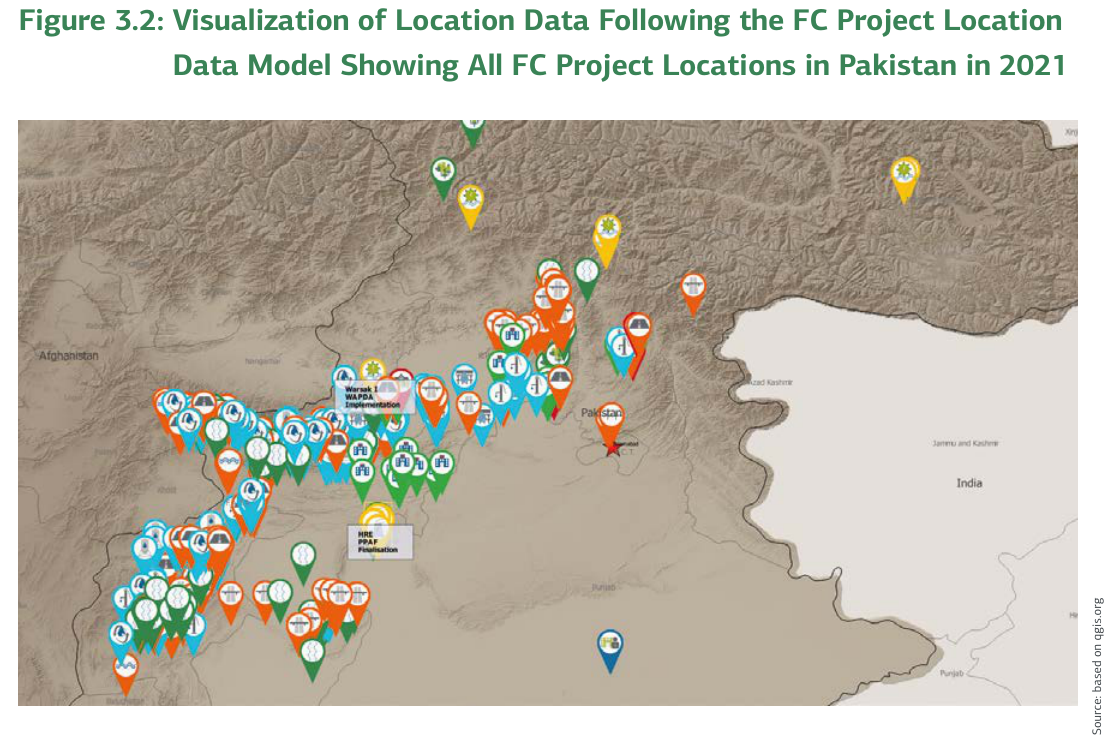
The above map shows all FC project locations under preparation and implementation in Pakistan in a uniform way.
Some of the locations are showing a selection of filter criteria (e.g., project title acronym, name of the PEA, implementation status of the location activity).
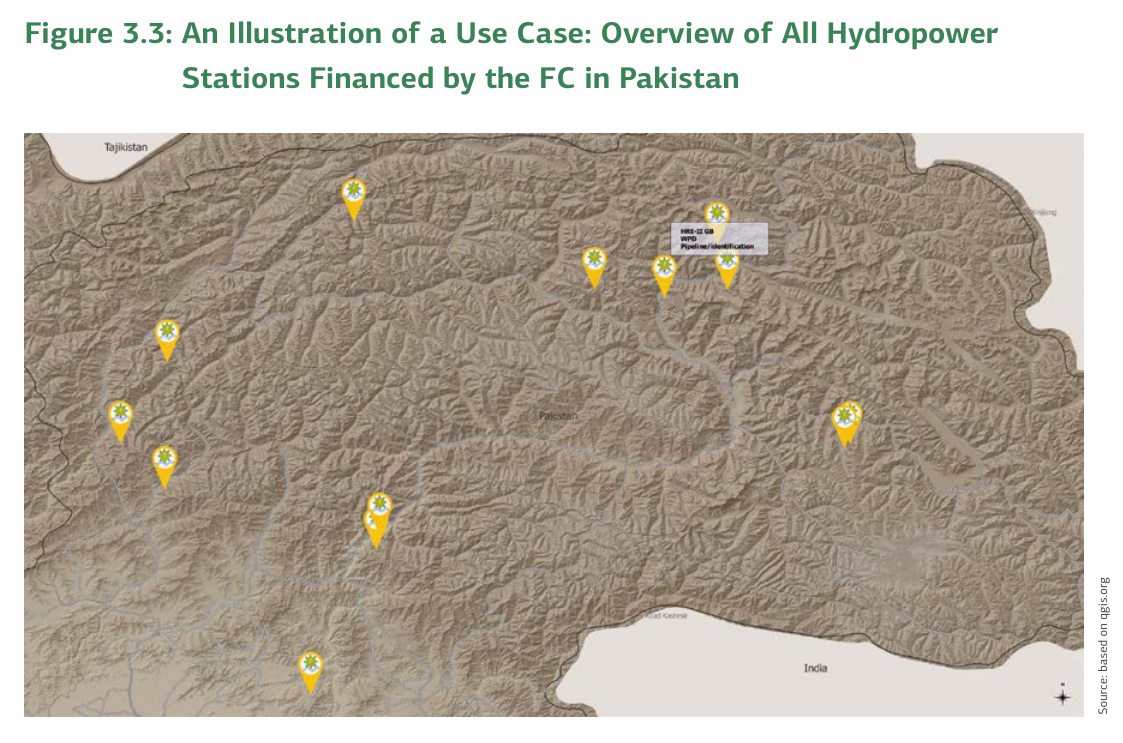
Now, all hydropower plant locations in Pakistan can be selected with one click:
Figure 3.3: An Illustration of a Use Case: Overview of All Hydropower Stations Financed by the FC in Pakistan
project. If different potential PEAs are considered, the organization's willingness may be a crucial selection factor. Therefore, the consultant must analyze whether the potential PEA(s) is/are willing to share relevant data, and which set(s) of institutional approaches and technical tool types they are or propose using.
- Analysis of PEA(s) experience and capacity with RMMV and proposed approaches: The consultant is to analyze the reliability of monitoring approaches and tools currently used by the PEA(s). If the PEA(s) already use(s) tools, the consultant is to assess whether these can be used or extended or additional tools or tool types are required. If the PEA uses a (Remote) Management Information System, see also, > Fact Sheet (Remote) Management Information System ToR Case B.
- Analysis of the local market for architects/planners and construction firms: If international and national firms cannot access the project sites, the project may have to rely on local planners and construction firms. In such cases, the consultant is to analyze whether there are local firms capable of and potentially willing to perform the required tasks.
- Analysis of the (local) market of monitoring consultants, IT experts and technical tool providers: the proposed set of RMMV approaches and tool types may require specific (local) expertise. How can this expertise be identified and engaged? Some tool types may be only accessible through certain public providers determined by the government (e.g., satellites or drones in some countries). How can these be procured? These issues need to be considered in the Feasibility Study.
This map of Pakistan shows the hydropower plant location, acronym of the project title "the respective project location is part of", "name of the PEA responsible for the project this location is part of" as well as the "implementation status of the main activity at the respective location".
The detailed FC Project Location Data Model and Management Approach, including the specific technical requirements, data collection ToR are presented in > Annex 3.
The same data collection Terms of Reference (ToR) have to be included as Sub-Annex to the Reporting Annex 8 of the project's Separate Agreement (> Section 3.1.4.2 Addressing RMMV in the Separate Agreement) as well as in the ToR of the respective consultant in charge of data collection, > Section 3.1.5.1 General ToR Aspects for the Implementation of an RMMV Approach.
3.1.2.4 Stakeholder Analysis and Incentive Model
As part of the Feasibility Study, project stakeholders and their respective positive and negative incentives are generally analyzed and incentive models for stakeholders are developed.
If RMMV approaches are to be used in the project, the analysis of such positive and negative incentives must include the following aspects:
- Target group analysis: if the target group is supposed to participate in the use of technical tools, the consultant must analyze local IT access conditions as well as the target groups' incentives as well as their actual IT-access disaggregated by gender, relative wealth, age, literacy (digital divide), relative remoteness (urban/rural divide) etc. to avoid unacceptably high levels of bias, and/or create awareness of bias considered acceptable or desired (e.g., bias towards youth in mobile feedback systems, which is underrepresented in traditional decision-making systems).
- Peace and Conflict Assessment: The Peace and Conflict Assessment is to propose methods for reliable Remote Monitoring of do-no-harm indicators and their assessment as to potential capacity gaps and conflicts of interest among the project stakeholders, forming the basis for the do-no-harm matrix (KFG-Matrix).
- Analysis of PEA willingness to appropriately use RMMV approaches: The PEA's willingness to use/ allow RMMV approaches appropriately is crucial to the success of a remotely managed and/or monitored
3.1.2.5 Environmental and Social Impact Assessment as Part of the Feasibility Phase
If RMMV approaches are to be used due to limited project site access, it must be clarified first, if potential environmental and social risk and impacts can be identified, whether these can be adequately assessed and subsequently managed and monitored via the applied RMMV approach or whether there are limitations or the project may even be unfeasible in a remote modality. Similarly, with regard to the aspects mentioned in the subsections above, the Feasibility Study consultant needs to analyze the possibilities and limitations of RMMV approaches for the a) identification and analysis of stakeholders and PAP, and b) socioeconomic baseline surveys, as well as census for resettlement and livelihood restoration.
Ideally the Environmental and Social Impact Assessment (ESIA) should be designed as an integral part of project design, such as in mainstreaming ESIA and ESMPs as part of participatory planning processes, or as a self-selection mechanism for small investment funds or programs (self-selection could for example result in exclusion of all proposals for sites where there have been any complaints by PAP).
The identification of environmental and social risks and impacts should be an integral part of the feasibility phase. Depending on the project type, scope and identified environmental and social risk category (A=high risk, B+=substantial risk, B=moderate risk and C=low risk), the Feasibility Study should include an assessment of environmental and social risks (for programs, an environmental and social framework is needed, as subprojects are not identified before appraisal). This should always include an E&S screening and scoping study or a section within the Feasibility Study. For high and substantial risks, an ESIA needs to be conducted within an independent document in the Feasibility Study phase by competent consultants as adequate preparation for the project appraisal. For moderate risk it has to be discussed whether an ESIA is needed or whether a site risk assessment, as part of the Environmental and Social Management Plan (ESMP), in the implementation phase is sufficient. The consultant needs to discuss with KfW and PEA whether and how RMMV approaches can be applied for the assessment of E&S aspects in the Feasibility Study phase.
For some risks related to category A and B+, the application of RMMV approaches may be limited and/or may involve challenges. In general, social aspects are more difficult to manage in a virtual environment. For example, applying RMMV approaches for World Bank ESS 5 on involuntary resettlement is challenging. Conducting socioeconomic baseline studies or census surveys for resettlement and livelihood restoration, including stakeholder engagement, may be difficult and require a tailored solution depending on the institutional approach used and on the technical RMMV tool types and data sources available, > Section 2.5 RMMV Decision Matrix. ESS 5 requires that the PAP be compensated before the impact materializes, thus there is a need for sufficient data to be available in a timely and reliable manner, while the compensation and livelihood restoration process needs to be implemented and monitored adequately as well. The same holds true for WB ESS 7 on indigenous people (IP), especially regarding the obtaining of the free prior informed consent (FPIC). In addition, one must be careful in applying RMMV approaches in the context of resettlement and IPs, as civil society actors view technical tools and approaches critically. Also, biodiversity baseline studies in natural or critical habitats may not be possible with all institutional approaches.
In addition, it needs to be clarified whether local consultants are available and competent enough to conduct screening, scoping and full-fledged ESIA (if required), whether or not guided by international experts. Many RMMV approaches feature a strong emphasis on consultants or even local consultants, thus the ToR for these assignments must be carefully developed and the consultants must demonstrate in their technical offer how they would apply RMMV approaches for each project task. For instance, it should be clarified which (satellite) data and tools they intend to use for what task. As an example: onsite bird flight monitoring in sensitive locations to determine if a given site is a critical habitat.
If in the pre-assessment considerable human rights risks are identified connected with the technical tool types you are planning to use, you may include a human rights risk assessment as part of your scoping or Feasibility Study. The Danish Institute for Human Rights provides useful guidance on > Human Rights Impact Assessment (HRIA) of Digital Activities, such as what to consider in the Terms of Reference for planning and scoping digital activities: > https://www.humanrights.dk/sites/humanrights.dk/files/media/document/Phase%201_Planning%20and%20 Scoping_ENG_accessible.pdf
If the technical tools you are planning to use for your project contain one or more of the following elements, you may consult the digital rights check developed jointly by KfW, GIZ and the Danish Institute for Human Rights: > https://digitalrights-check.bmz-digital.global/kfw/ and check the recommendations for the respective element(s) as well as the respective Tool Type Fact Sheets referenced below:
- Smartphone app > Fact Sheet Mobile Data Collection Tools
- eLearning tool > Fact Sheet eLearning Tools
- Internet-of-Things (IoT) device > Fact Sheet Sensors/Smart Meters
- Digital social or communications platform (incl. social media) > Fact Sheet Crowdsourcing Tools and > Fact Sheet Collaboration Tools
- Cloud services > Fact Sheet R/MIS and > Fact Sheet Data Sources
- Artificial intelligence solutions > Fact Sheet Data Sources
- FinTech solution > Fact Sheet Collaboration Tools
- Digital ID systems > Fact Sheet R/MIS and > Fact Sheet MMS
3.1.2.6 Local ICT Access Conditions
Local ICT access conditions must be assessed as part of the Feasibility Study because these are relevant for all tool types using mobile phones and a local internet connection. These may be mobile data collection tools, crowdsourcing tools, big data sources, R/MIS, Maintenance Management Systems, camera-based remote sensing, sensors or smart meters (internet-ofthings), > Tool Types Fact Sheets. Considering the precarious data situation in most partner countries, choices are often limited for the collection of accurate and representative data. The likelihood of reaching a near-representative or at least socially inclusive share of the population through mobile survey technology will increase along with rates of mobile phone penetration, household mobile phone ownership, the functional and ICT literacy of women and other vulnerable or marginalized groups, ICT affordability, and ICT connectivity. At least, the following topics are to be considered.
- Access to electricity: In Sub-Saharan Africa, some 600 million people (almost two-thirds of the region's population) do not have regular electricity, while 15% have no electricity access at all. 12 However, this however only severely limits mobile phone network access for people with no electricity access at all.
- Mobile phone ownership: In 2024, 5.61 billion people worldwide used a mobile phone (equaling 69.4% network access, of which an estimated half are smartphones). 13 However, Asian-Pacific and African countries in particular lag behind. While the percentage of smartphone use is increasing (by the end of 2020, over 4 billion people were using mobile internet, representing 51% of the world's population) 14, poor and rural populations in particular only have access to simple mobile phones without broadband access or the advanced computing functions of a smartphone. Currently, cross-national data sets on mobile phone penetration, such as provided by the World Bank, are based on estimations of the number of cellular subscriptions. However, this may not accurately reflect penetration (i.e., the percentage of phone owners among the population), as one person may own multiple mobile phones. An increasing but still limited number of national statistical institutes of developing countries are providing more accurate information on mobile phone ownership.
- Access to internet: Basic access to broadband internet is available in every capital and larger city around the world, but rural communities are often excluded. In January 2024, 5.35 billion people use the internet (66%). 15 Merely 45.5% of people in Africa have access to the internet today though 16, and current growth trends suggest we will be well into the second half of the 2020s before we see internet access levels across the continent pass the 50% mark. Broadband access rates are even worse, especially in remote and rural areas. In many countries, broadband internet is quite expensive. High prices may exclude poor people from usage, even when network access is available.
- Network infrastructure: One common reason why people do not access the internet is poor mobile network infrastructure. For projects where mobile phones needed to transfer data, it is recommended to use a mobile operator with at least 3G net coverage, otherwise long waiting times may occur. 3G net coverage is given in most countries in the world, but the available net coverage differs regionally. 4G coverage had increased to 84% in lower-middle-income countries (LMIC) by the end of 2020.
- Usage gap: Even though the coverage gap has narrowed in recent years (see above), there is still a huge gap in usage. In 2022, 38% or 3 billion people did not use mobile internet despite living in areas with mobile broadband coverage. 17
- Gender gap: There is also a sobering gender gap online. In developing countries, the parity between male and female internet users can be startling. In Sub-Saharan Africa, the gender gap can range from 10-62%. 18 Women in low and middle-income countries are, on average, 17% less likely to own a mobile phone than men, and 19% less likely to use mobile internet. 19 The gender gap is significantly lower in urban than in rural areas, and for younger versus older women. In addition to mobile phone access, there is also a gender gap regarding phone use due to illiteracy, functional literacy or limitation to the local language (as opposed to the official language), which must be considered.
- National ICT expertise: Moreover, the existence of progressive and pro-competitive regulatory ICT-policy frameworks and national ICT R&D funds are usually associated with higher levels of in-country ICT expertise. This, in turn, would be an enabling factor for realization of the technical infrastructure for the project. National ICT experts will likely be better qualified to develop software solutions that are suited to the specific local context and to sustainably maintain the necessary hardware than external international consultants. During the Feasibility Study, to gain a better understanding of the telecommunications environment we recommend consulting the following sources to analyze the local ICT access conditions:
- International Tele-Communication Union: ICT Development Index > https://www.itu.int/en/ITU-D/Statistics/Pages/IDI/default.aspx;
- Alliance for affordable internet: Affordability Report > https://a4ai.org/research/affordability-report/ affordability-report-2021/;
- GSMA: Mobile Connectivity Index > https://www.mobileconnectivityindex.com/ and > https://www.gsma. com/solutions-and-impact/connectivity-for-good/mobile-for-development/connected-women/, and > https://www.gsma.com/solutions-and-impact/connectivity-for-good/external-affairs/
- Internet World Stats (offers statistical indicators about internet usage for every country) > https://data.worldbank.org/indicator/IT.NET.USER.ZS.
Solutions should be adapted to local energy and ICT access conditions, but adaptations may be possible. For example, electricity can be provided through solar panels. If the network signal is too weak to transfer data immediately, mobile phones can be used as buffer memory and the data can be transferred later when there is better net coverage. Camera and UAV/drone-based sensors can load data onto a data storage device which can then be manually read at regular intervals.
12 https://openknowledge.worldbank.org/bitstream/handle/10986/31333/9781464813610.pdf?seq and https://www.iea.org/reports/world-energy-outlook-2023 13 https://wearesocial.com/uk/blog/2024/01/digital-2024/ 14 https://www.gsma.com/r/wp-content/uploads/2021/09/The-State-of-Mobile-Internet-Connectivity-Report-2021.pdf
15 https://wearesocial.com/uk/blog/2024/01/digital-2024 16 https://www.statista.com/statistics/1318881/internet-usage-rate-in-africa-by-gender/ 17 https://www.gsma.com/r/somic/ 18 https://www.weforum.org/publications/global-gender-gap-report-2024/ 19 https://www.gsma.com/r/somic/
3.1.2.7 Implications of Using RMMV Regarding Project Cost and Duration
RMMV may have different effects on project cost and duration that should be taken into consideration when assessing project feasibility and drafting the project budget and time schedule outline as part of the Feasibility Study. The implications are discussed in this Section.
Cost and resource implications at KfW-level At KfW-level, transaction cost may increase. Remote Management and Verification of projects may be more expensive than regular project management and verification. Even though international staff may spend less time traveling, remote project management and Remote Verification imply greater workload. Portfolio managers may have to recruit and manage additional consultants, including preparations for their missions, managing their contracts and addressing findings after the mission. If KfW national experts take more responsibility, for example, in supporting Remote Verification and coordination among KfW staff, partners and stakeholders , they must be trained and coached by international KfW staff. Finally, communication with the PEA may take more time and require more rescheduling and troubleshooting effort in the absence of a possibility to hold clarifying meetings during a mission.
Cost implications at project-level At project-level, cost implications depend on the institutional RMMV approach(es), tool types and data sources chosen > Section 2 RMMV Approaches and Tools - an Overview. Some empirical data indicative of the cost implications of different institutional approaches is available (> Section 2.1 for a discussion of institutional approaches):
- The cost implications of an Implementation Consultant with increased local capacity (> Section 2.1.1, A3) may vary: while increasing reliance on local staff may be cheaper, the cost of training and supervising them may be significantly greater, as well as security and flight costs (for intermittent trips by international staff). For some projects relying strongly on RMMV because of conflict-related site access issues, consulting cost has tripled.
- Costs for monitoring consultants depend on the range of services they provide (> Section 2.1.1, A2 and A3): In general, monitoring consultants have the same monthly rates as Implementation Consultants. However, the range of services demanded of monitoring consultants can differ substantially. If monitoring consultants have a limited mandate, they may only cost a small fraction of the total project volume. The more implementation responsibility the consultant takes on, the more expensive it gets.
- Third-party monitoring consultants are relatively affordable (> Section 2.1.1, A4). Usually they also cost a small fraction (1 to 5%) of the total project volume, assuming that only a sample of outputs and/or outcomes is monitored. It must be considered however that frequently a TPM consultant is recruited in addition to an Implementation Consultant, which increases overhead cost.
- Third-party monitoring through technical audit is even more affordable (> Section 2.1.1, A4): this approach, used for example in a KfW-financed project in Yemen, was estimated to cost less than 1% of the overall project sum. This was of course also due to its limited scope.
The cost of hiring additional national technical experts at KfW country office level is not included in the project budget, as they are tasked with conducting KfW Remote Verification activities and usually cover KfW's entire sector portfolio in the country (> Section 2.1.1, A1).
For technical tools, cost is not the main selection criterion, and it is also more difficult to estimate their cost implications, as these include software, hardware, training, promotion activities, etc. However, some empirical data is available:
- Hardware and data can come at relatively low cost. Examples of this are socioeconomic databases (mostly open and free), satellite-based remote sensing (usually less than EUR 10 per image per sqm) and camera-based remote sensing (a 360-degree camera can cost between EUR 150 and EUR 1,000) and intelligent sensing (sensors cost can vary between EUR 1 and EUR 500 per unit).
- Standard monitoring or data analysis and visualization tools can be significantly cheaper if existing (open) data sources are initially or from periodically combined with project-generated data through a data dashboard solution (e.g., Power BI, Tableau etc.).
- Software development services and software licensing fees can be relatively expensive. The original development of a proprietary remote project management information system did cost about EUR 120,000 in 2018 in addition to annual licensing fees. If open-source software is used, these costs can be substantially lower. Adaptation of the open-source Rapidpro software for the citizen monitoring project in Togo was only a fraction, without any licensing fees, > Decentralization Support Program in Togo (PN: 30205).
- Other cost items required for technical tool types also need to be considered. These include IT equipment (computers, smartphones, servers), training on software development, content management and/or user training, promotion and social mobilization activities, subsidizing of short message service (SMS) fees (e.g., for mobile data collection or crowdsourcing) and regular updates and maintenance.
Implications of RMMV for Project Duration Implications regarding duration depend on the selected institutional approach as well as the software requirements for the selected technical tool(s):
- Setting up a Remote Management Information System (R/MIS) takes time. If software crucial for progress monitoring needs to be developed or adapted, this can delay the start of construction works in a project. Software development usually requires a sequence of programming and feedback from users. This process may take up to six months and delay project start. Therefore it should be part of the ToR of the Implementation Consultant (or additional IT consultant), and start in parallel with the planning stage or be procured by the PEA parallel to the procurement of the Implementation Consultant (as done in the > Stabilization Program M-naka, Mali, (PN: 38771).
- Deployment of UAV/drones may also take time. Drones frequently need to be imported and may be stuck at customs. Furthermore, obtaining the necessary permits to operate the drone may take additional time.
3.1.2.8 Considerations on Designing KfW's Remote Verification Approach
If due to the security situation or other project-specific circumstances the physical verification steps (appraisal, progress and final review, including the verification of the use of funds as well as ex post evaluation) are not possible or cannot be carried out by KfW itself wholly or in part, this must already be taken into account in the Feasibility Study if such a risk has already been identified at that stage. In such case, all these steps have to be conducted using the RMMV approach (choice of institutional approaches as well as types of technical tools and data sources) in accordance with > Section 2, in particular > Section 2.5 RMMV Decision Matrix as well as > Section 3.3 Remote Verification of Project Progress by KfW. In designing the RMMV approach as part of the Feasibility Study, the expected reporting from the Remote Monitoring of project implementation is considered (> Section 3.2 Project Implementation and Monitoring by The PEA/Consultant) and combined with additional, independent sources of information. The RMMV approach design is then agreed in the contractual setup for procuring technical tool types, > Section 3.1.5.1 General ToR Aspects for the Implementation of an RMMV Approach.
If adequate Remote Verification procedures cannot be identified, the feasibility of the project needs to be discussed with the respective KfW client for the project, > Section 1.5.1 Limitations.
3.1.3 Conducting Project Appraisals Remotely
It is important to consider RMMV in this step within the FC project cycle because it constitutes the first verification process for KfW, enabling KfW to verify the results of the Feasibility Study. Furthermore, crucial elements of the project, including the relevant mix of institutional approaches and tool types, are defined with the PEA in the appraisal, and KfW's client is informed of the chosen RMMV approach and related RMMV risks.
Please note that this Section does not outline guidelines for the general KfW project appraisal process but rather only discusses additional aspects that should be considered when conducting project appraisals remotely.
If due to the security situation or other specific circumstances of the project a physical appraisal mission is not possible or cannot be carried out by KfW itself, wholly or in part, this must already be taken into account in the project planning phase if such a risk has already been identified at that stage. In such case, remote appraisal has to be conducted using the RMMV approach (choice of institutional approaches as well as types of technical tools and data sources) in accordance with Section 2, in particular > Section 2.5 RMMV Decision Matrix as well as the sections below. The proposed RMMV approach should already be stated in the appraisal concept and discussed during the appraisal peer review.
If adequate Remote Verification procedures are not available, the feasibility of the project needs to be discussed with the respective client of KfW for the project, > Section 1.5.1 Limitations.
3.1.3.1 Preparation of Remote Appraisals
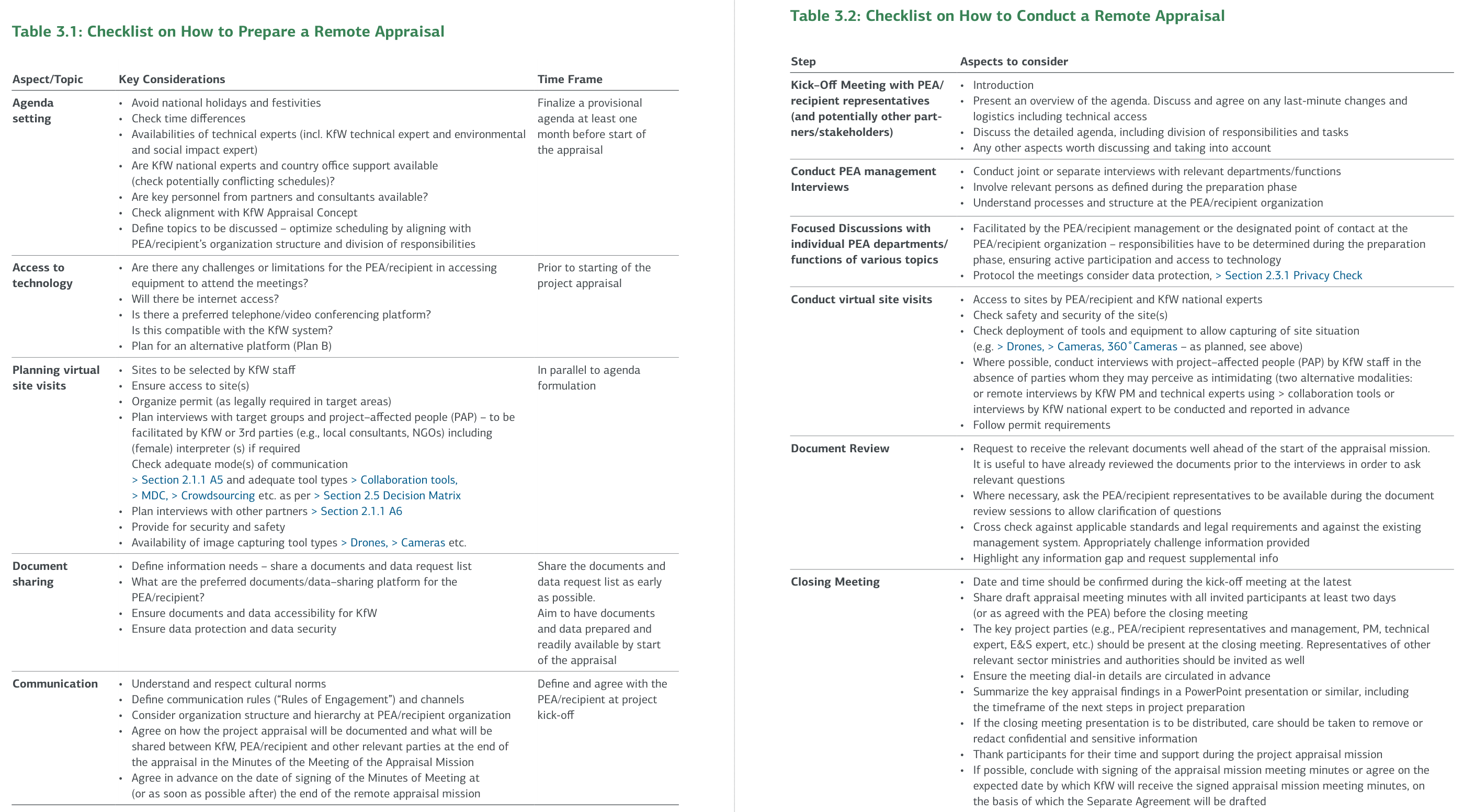
A well-designed appraisal concept is necessary to successfully conduct a project appraisal remotely. Sufficient time should be reserved for the preparation of a remote appraisal mission to ensure an optimized process and efficient data collection. The PM has responsibility for coordination and ensuring that the appraisal is well planned. External inputs are essential to the success of a project appraisal, thus it is recommended to involve the relevant parties (in particular the relevant PEA, recipient government and target groups representatives, as well as other partners and stakeholders) as early as possible, and to ensure their availability and access to the required IT-infrastructure. Frequently, additional data needs to be collected in advance of the remote appraisal mission which otherwise would have been collected on site during the mission.
The following should be considered and planned for in coordination with the PEA/recipient:
Table 3.1: Checklist on How to Prepare a Remote Appraisal
3.1.3.2 Conducting Virtual Appraisal Missions
A Virtual Appraisal Mission is likely to take place over a series of telephone/video conferences and involve accessing of technical tool types and data sources, depending on the setup as determined during the preparation phase. The approach should allow a level of flexibility, and potentially for the participation of additional technical experts. However, a high level of coordination is required to ensure efficient use of time and that the information obtained reflects as accurately as possible the likely risks and impacts of the project. It is therefore recommended to confirm the appraisal agenda with the PEA/recipient at least two weeks prior to start of the project appraisal as well as other logistical aspects mentioned above.
The following illustrates the process of conducting a typical virtual project appraisal and aspects to be considered:
Table 3.2: Checklist on How to Conduct a Remote Appraisal
Step Aspects to consider
Aspect/Topic Key Considerations Time Frame
Kick-Off Meeting with PEA/
- Introduction Agenda setting Access to technology
- Avoid national holidays and festivities
- Check time differences
- Availabilities of technical experts (incl. KfW technical expert and environmental and social impact expert)
- Are KfW national experts and country office support available (check potentially conflicting schedules)?
- Are key personnel from partners and consultants available?
- Check alignment with KfW Appraisal Concept
- Define topics to be discussed - optimize scheduling by aligning with PEA/recipient's organization structure and division of responsibilities
- Are there any challenges or limitations for the PEA/recipient in accessing equipment to attend the meetings?
Finalize a provisional agenda at least one month before start of the appraisal
Prior to starting of the project appraisal
recipient representatives (and potentially other partners/stakeholders)
Conduct PEA management Interviews
Focused Discussions with individual PEA departments/ functions of various topics
- Present an overview of the agenda. Discuss and agree on any last-minute changes and logistics including technical access
- Discuss the detailed agenda, including division of responsibilities and tasks
- Any other aspects worth discussing and taking into account
- Conduct joint or separate interviews with relevant departments/functions
- Involve relevant persons as defined during the preparation phase
- Understand processes and structure at the PEA/recipient organization
- Facilitated by the PEA/recipient management or the designated point of contact at the PEA/recipient organization - responsibilities have to be determined during the preparation phase, ensuring active participation and access to technology
- Protocol the meetings consider data protection, > Section 2.3.1 Privacy Check Planning virtual site visits Document sharing
- Will there be internet access?
- Is there a preferred telephone/video conferencing platform? Is this compatible with the KfW system?
- Plan for an alternative platform (Plan B)
- Sites to be selected by KfW staff
- Ensure access to site(s)
- Organize permit (as legally required in target areas)
- Plan interviews with target groups and project-affected people (PAP) - to be facilitated by KfW or 3rd parties (e.g., local consultants, NGOs) including (female) interpreter (s) if required Check adequate mode(s) of communication > Section 2.1.1 A5 and adequate tool types > Collaboration tools, > MDC, > Crowdsourcing etc. as per > Section 2.5 Decision Matrix
- Plan interviews with other partners > Section 2.1.1 A6
- Provide for security and safety
- Availability of image capturing tool types > Drones, > Cameras etc.
- Define information needs - share a documents and data request list
- What are the preferred documents/data-sharing platform for the PEA/recipient?
- Ensure documents and data accessibility for KfW
- Ensure data protection and data security
In parallel to agenda formulation
Share the documents and data request list as early as possible. Aim to have documents and data prepared and readily available by start of the appraisal Conduct virtual site visits
- Access to sites by PEA/recipient and KfW national experts
- Check safety and security of the site(s)
- Check deployment of tools and equipment to allow capturing of site situation (e.g. > Drones, > Cameras, 360?Cameras - as planned, see above)
- Where possible, conduct interviews with project-affected people (PAP) by KfW staff in the absence of parties whom they may perceive as intimidating (two alternative modalities: or remote interviews by KfW PM and technical experts using > collaboration tools or interviews by KfW national expert to be conducted and reported in advance
- Follow permit requirements Document Review
- Request to receive the relevant documents well ahead of the start of the appraisal mission. It is useful to have already reviewed the documents prior to the interviews in order to ask relevant questions
- Where necessary, ask the PEA/recipient representatives to be available during the document review sessions to allow clarification of questions
- Cross check against applicable standards and legal requirements and against the existing management system. Appropriately challenge information provided
- Highlight any information gap and request supplemental info Closing Meeting
- Date and time should be confirmed during the kick-off meeting at the latest
- Share draft appraisal meeting minutes with all invited participants at least two days (or as agreed with the PEA) before the closing meeting
- The key project parties (e.g., PEA/recipient representatives and management, PM, technical expert, E&S expert, etc.) should be present at the closing meeting. Representatives of other relevant sector ministries and authorities should be invited as well Communication
- Understand and respect cultural norms
- Define communication rules ("Rules of Engagement") and channels
- Consider organization structure and hierarchy at PEA/recipient organization
- Agree on how the project appraisal will be documented and what will be shared between KfW, PEA/recipient and other relevant parties at the end of the appraisal in the Minutes of the Meeting of the Appraisal Mission
- Agree in advance on the date of signing of the Minutes of Meeting at (or as soon as possible after) the end of the remote appraisal mission Define and agree with the PEA/recipient at project kick-off
- Ensure the meeting dial-in details are circulated in advance
- Summarize the key appraisal findings in a PowerPoint presentation or similar, including the timeframe of the next steps in project preparation
- If the closing meeting presentation is to be distributed, care should be taken to remove or redact confidential and sensitive information
- Thank participants for their time and support during the project appraisal mission
- If possible, conclude with signing of the appraisal mission meeting minutes or agree on the expected date by which KfW will receive the signed appraisal mission meeting minutes, on the basis of which the Separate Agreement will be drafted
3.1.3.3 Environmental and Social Considerations of Virtual Appraisal Missions
In general, the pre-appraisal phase consists of a desktop review of the conducted studies (Feasibility Study, ESIA, etc.) and discussions with consultants and partners on open issues. A list of open questions should be sent to the partner before the appraisal mission so they can prepare for the appraisal mission. Based on the conducted studies, it is also good practice-required-to develop a draft version of the Environmental and Social Commitment Plan (ESCP) before the appraisal mission and send the draft to the partners for discussion during the mission. In addition, we recommend using the KfW > Digital Rights Check before or during the appraisal mission, if you need to identify and mitigation potential human rights risks from the use of RMMV tools or other digital technologies within the project.
This approach is also feasible for virtual appraisal missions. Physical presence in the country and/or project region is not possible in this case, so the meetings and/or site visit have to be conducted virtually. It is good practice to prepare the virtual appraisal as diligently as one would a "normal" appraisal, with a clear agenda and stating exactly who has to be present at which meetings. For instance, the E&S team of the partner and KfW obviously have to be present at the meetings on environmental and social topics, but the KfW project team needs to analyze and discuss at what further sessions the E&S staff need to be included, as it is vital to include them in the sessions on the project Implementation Consultant or the procurement documents, for example (as there are relevant ESHS requirements which need to be discussed).
Virtual site visits can be conducted via web conferencing, image-assisted site assessment, 360?/helm mounted cameras, etc., see Fact Sheets on > Collaboration Tools, > Mobile Data Collection Tools, and > Cameras.
Virtual meetings with communities/PAPs may be difficult, but at least interviews with PAPs can be conducted using a mobile phone with camera and streamed within a web conferencing tool, > Collaboration Tools.
Ad-hoc discussions with stakeholders are difficult to do, and triangulation of information by interviewing stakeholders randomly is difficult as well. But if the security situation allows, KfW national experts can be present in the project area before or during the appraisal mission and can interview stakeholders randomly chosen by KfW from a list made available by the Feasibility Study consultant or PEA.
Virtual Meetings with PAPs without project partners would be a possibility to get unfiltered information for unbiased opinions, but this requires that partner institutions' staff are not involved in the interviews,being organized and conducted for example by KfW national experts. It is additionally important that the PAPs/ communities are randomly chosen by KfW (e.g., from the list of PAPs from the resettlement action plan) for such virtual interviews, and are not proposed/selected by the project partners.
Similarly, any necessary meetings with NGOs or workers unions must be organized and it must be clarified in advance whether those meetings are to be done with or without the presence of partner institutions. Interpreters are required in any case. Finally, care must be taken, that the integrity of interviewed PAPs is assured.
3.1.4 Contractual Considerations
To ensure the successful implementation of a RMMV-strategy it is imperative that the key underlying project agreements (Grant or Loan Agreement, Separate Agreement and consultancy contract(s)) clearly regulate the RMMV-related rights and obligations of the respective parties in a legally binding way.
3.1.4.1 Addressing Crucial RMMV Prerequisites in the Grant or Loan Agreement
In rare cases, if RMMV-related prerequisites have been identified during project preparation are so crucial for the success of the project that it would otherwise fail, or KfW cannot other verify the use of funds, those prerequisite(s) should be agreed during the course of the government negotiations (> Section 3.1.1 Government Negotiations) or during the project appraisal mission (> Section 3.1.3 Conducting Project Appraisals remotely). In such cases, and given the importance of such prerequisites, it may be appropriate to include these in the respective Grant or Loan Agreement (e.g., as undertakings, covenants or conditions precedent to disbursement). One example for such a prerequisite is the need to ensure access by KfW or the respective third party to necessary information from a partner's R/MIS. If this is considered uncertain or if there is a risk of potential RMMV-related human rights issues (e.g., data protection provisions in citizen feedback loops or use of AI-assisted big data), consideration in the a.m. agreements is strongly recommended.
The issues/prerequisites have to be identified (e.g., in the Feasibility Study) and discussed at an early stage (ideally at the project preparation kickoff-meeting) with the KfW contract manager and/or the KfW legal team to clarify what changes if any will have to be made to the relevant Grant or Loan Agreement template 20, and which will therefore have to be included in the Project Proposal as an implementation condition requiring the approval of the BMZ.
For less crucial RMMV-prerequisites/project-specific RMMV-requirements it may however still be appropriate to address these in the Grant or Loan Agreement (e.g., Art. 1.2 Purpose of the Grant/Loan or Art. 6 Obligations of the Recipient/Borrower/PEA), or alternatively in the Separate Agreement which is the part of the respective Grant or Loan Agreement that describes the project purpose and details 21. Such RMMV prerequisites/project-specific requirements may, for example, be included in Art. 2.4.2 Special Implementation Agreements of the Separate Agreement, or elsewhere therein, as appropriate (see below).
3.1.4.2 Addressing RMMV in the Separate Agreement
In the Separate Agreement of a FC project, all its more technical details and other important aspects are described, including the project objectives, activities, timeline, budget, reporting as well as the roles and responsibilities of all project parties. Therefore, the RMMV approach should be mentioned in Art. 1.1 Details of the Project of the Separate Agreement and should state the mix of institutional approaches and technical tool types and data sources that was proposed in the Feasibility Study (> Section 3.1.2 Feasibility Study) and/or agreed in the Minutes of Meeting of the Appraisal Mission (> Section 3.1.3.2 Conducting Virtual Appraisal Missions) or subsequently. If there are any important prerequisites to successfully implementing the agreed RMMV approach which are not already covered in the Grant or Loan Agreement (> Section 3.1.4.1 Addressing Crucial RMMV Prerequisites in the Grant or Loan Agreement), these should be reflected in Art. 2.4 Special Implementation Agreements of the Separate Agreement.
The main RMMV-related activities of the project should be also considered in Art. 1.2 Time Schedule as well as Art. 1.3 Total Cost and Financing and in the Procurement Plan (Annex 7), as appropriate, and if they are not purely related to Remote Verification by KfW (such as a consultant for Third-Party Verification, which would be managed and financed by KfW only):
- Cost and Financing Schedule: The financing of the costs for each of the RMMV approaches should be clearly allocated between the project parties. These include initial "setup" costs (such as software, staff training, etc.) and potential long-term costs (e.g., software license renewal). RMMV costs should be clearly stated in the Total Cost and Financing Annex to the Separate Agreement. If additional parties are to be contracted independently by the PEA to implement the RMMV approach, e.g., for Third-Party Monitoring, these also need to be considered in the Procurement Plan Annex and the Disbursement Procedure Annex.
- If RMMV approaches require procurement methods deviating from international competitive practice, this should be specified in the Separate Agreement inappropriate for inclusion in the Grant or Loan Agreement. Some RMMV approaches, technical tool types or data sources may require direct procurement or limited bid solicitations, for instance of the Third-Party Monitoring consultant or of a specific software. If such is the case, the respective internal standard procurement procedures of KfW apply and the corresponding outcomes must be documented in the Procurement Plan (Annex 7) of the Separate Agreement.
The respective responsibilities and obligations of the project parties with regard to implementation of the RMMV approach are to be set out clearly in Art. 2.1 of the Separate Agreement: Responsibilities and Time, Cost and Financing Schedule or in the respective Annexes to the Separate Agreement (including Annex 8 Content and Form of Reporting to KfW). This concerns in particular obligations of the recipient, the PEA and any additional project parties, as well as of the Implementation Consultant with regard to project implementation and reporting. This could include the rationale for and development of the RMMV approach, provision of information, procurement, use of tool types, data sources, and so on.
In any case where RMMV activities or outcomes are expected to continue after the project ends, the obligations of an institution responsible for the operation of the project or its infrastructure or services must additionally be stated in Art. 2.1 of the Separate Agreement.
20 (i.e., the template Grant or Loan Agreement agreed with the BMZ) 21 The Separate Agreement is the agreement entered into by and between the KfW and the Recipient and/or PEA, in which all project-specific implementation details are set out and which is part of its respective Grant or Loan Agreement.
The respective rights and obligations of the parties should include the following:
i) The types of information to be collected, by whom and by when (timing), and with whom such information can be shared (as applicable: the Recipient and/or PEA should be obligated to share information with the Implementation Consultant and with other relevant parties, such as third-party monitoring consultants (to be stated for example in Annex 8 on Reporting)
ii) Access to data or tools by KfW for (Remote) Verification: If the RMMV approach includes technical tools and/or data sources to which KfW requires access for its (Remote) Verification purposes, this should be mentioned in Art. 2.1 or Annex 8 (Reporting). In case project location data are to be collected, the Terms of Reference (ToR) for Project Location Data Collection have to be added as a Sub-Annex to the Reporting Annex 8 of the Separate Agreement (> Annex 3.2 The Project Location Template)
iii) A clear allocation of responsibility with regard to ensuring that data security and data protection requirements (including those of the relevant jurisdiction) are complied with. For example, if information is to be collected from target groups, the Recipient and/or PEA must ensure that such information will be collected in a secure, anonymous and uncensored manner (to be stated in Art. 2.1 or Annex 8 on Reporting); In fragile contexts, special data protection and security provisions should be addressed as part of the Separate Agreement (e.g., in Art. 2.1 or Annex 8) or as part of the ToR of the Implementation Consultant or other parties charged with the implementation of the respective RMMV technical tools and data sources (> Section 2.3.2 Information Security and Confidentiality in FC)
iv) If target groups or PAP are directly involved in monitoring, the PEA needs additionally to be obligated to share the unbiased and uncensored observations and feedback of target groups and to ensure inclusiveness in the selected approach, including the mitigation of digital divide risks regarding the exclusion of women or other vulnerable groups (e.g., in Art. 2.1 or Annex 8)
v) RMMV staffing requirements: The RMMV approaches may require the recipient and/or PEA to have suitably qualified staff (for monitoring, managing IT solutions, etc.). These requirements should be clearly specified in Art. 2.1 and/or Annex 3 (Total Cost and Financing); The assignment of any necessary consultants or other parties required to implement the RMMV approach should be stated in Art. 2.1. Such consultants may include Implementation Consultant, a monitoring consultant, a third-party monitoring consultant, an NGO or research institution and/or software/IT Implementation Consultants. It should be clear what the responsibilities of each such consultant/entity are and what interaction is required between the consultants/entities, if any. The responsibilities of each consultant and how the different actors are supposed to interact to achieve a set goal should therefore be included. In some cases, such as if procurement capacities are limited, it may be useful to include an agency contract in the Separate Agreement in which KfW agrees to procure the necessary consultants on behalf of the recipient and/or PEA
vi) Software, licenses, data ownership and their respective costs: The Separate Agreement (and/or Consulting Contract) should define who will obtain and maintain the software required for the chosen RMMV approach and who will cover which related costs during and after project implementation. Depending on the individual case, the details on software/license ownership, ownership of data derived therefrom and responsibility for software/license management and renewal may be defined at a later stage during project implementation as part of preparations for software procurement (> Section 2.2.2). If these matters have already been agreed, the specifics can be stated in Art. 2.1 and/or Annexes 3 and 8 of the Separate Agreement or Consulting Contract.
If any of the above aspects are considered uncertain or a considerable risk, they can be included in addition to or instead of the provisions per Art. 2.4 2 of the Separate Agreement, Special Implementation Agreements.
Any aspects of the RMMV approach relevant to Art. 2.2 of the Separate Agreement, Environmental, Social and Health and Safety Compliance, will need to be mentioned there and/or in its Annex 6 Environment.
3.1.5 RMMV Aspects in the ToR, Tendering and Contracting of Consulting Services
RMMV is important to consider in this step in the project cycle because the Drafting of the ToR and the Tendering and Contracting of Consulting Services are crucial to ensure that the respective consultants are assigned the tasks necessary for the mix of institutional approaches, tool types and data sources selected for the project, and are sufficiently and adequately staffed, equipped and qualified.
Ideally, the general ToR for the Implementation Consultant are already drafted as part of the Feasibility Study (> Section 3.1.2 Feasibility Study) or of the project appraisal (as stated in the appraisal mission Minutes of Meeting (> Section 3.1.3 Conducting Project Appraisals remotely), but they usually need to include considerations regarding the institutional setup of the project (> Section 3.1.5.1 General ToR Aspects for the Implementation of an RMMV Approach), be described in greater detail, be adapted to changing circumstances during the project preparation period and be supplemented with additional legal, technical and procurement details, > Section 2.1 Institutional Approaches, > Section 2.2 Overview on Technical Tool Types and > Section 2.3 Legal and Regulatory Conditions and Recommendations.
3.1.5.1 General ToR Aspects for the Implementation of an RMMV Approach
Develop Consulting setup and Terms of Reference (ToR): If any RMMV-related roles and obligations of the recipient and/or PEA are to be delegated to an Implementation Consultant, a (third-party) monitoring consultant or to other monitoring entities (e.g., technical and/or financial auditor, NGOs or research institutions), such roles and obligations must be included in the respective ToR and the consultancy contract to be agreed during contract negotiations. Depending on the RMMV approach applicable, the necessary tasks, equipment, tool type(s) and staffing concept must be specified in the ToR.
What to write in the ToR with respect to RMMV: At a minimum, the ToR should state what mix of institutional approaches, technical tool types and data sources has been agreed, thus defining the RMMV approach of the project 22, including the respective roles and responsibilities of the respective parties involved in implementing the RMMV approach.
A few recommendations worth highlighting from our past experience working with consultants on RMMV:
- Data quality: Independently of the type of consultant, the consultant should be responsible for ensuring data quality, including the quality of georeferencing (see below). This is important to have valid data, and also with the goal in mind that collected key data can later on be used by the KfW evaluation department FZ-E as well; this also requires determining modalities of its storage and eventual transmission to KfW at the end of the project, > Section 3.4 End of Project.
- Project Location Data: Collection, validation and management of project location data are particularly important for RMMV. Therefore, the KfW standard geo data model and its respective geodata collection ToR have to be included in the ToR of the consultant charged with this task, > Section 3.1.2.3 The Collection of Project Location Information and > Annex 3.2 The Project Location Template.
- Data protection, privacy, security, and other legal aspects: where personal(ized) and sensitive data are collected, ensuring data protection, privacy and security have to be part of the respective consultants' responsibilities, > Section 2.3 Legal and Regulatory Conditions and Recommendations.
- In fragile contexts, the security situation in consultant activity planning and budgeting needs to be considered: The security situation is very critical and volatile in some target regions or areas. The consultant's offer must contain procedures/methods for taking into account the security situation and obtaining professional advice from relevant risk professionals and state options for different security scenarios that include Remote Management and Monitoring of consultant activities and tasks - be it by replacing international with local consultant staff or by deploying appropriate technical tools (that feature auto-lock and data destruction safeguards for the technical tools and data sources that contain personal or other sensitive data). To protect staff members during work and travel to and within the project areas, the financial proposal must contain reimbursable costs for reasonable security measures for staff members, offices, living accommodations, vehicles, technical tools, data sources and other needed equipment, as recommended by professional security advisors. 22 Please Note: This Section only covers additional specifications on RMMV for ToRs.
Detailed ToR Templates have been developed for KfW staff and PEA for consultants to design RMMV approaches as part of the Feasibility Study and for consultants to design the setup or expansion of R/MIS for remote project management and monitoring. These ToR can be accessed by KfW staff via the internal KfW knowledge management system.
3.1.5.2 Contractual Setup-up for Procuring Technical Tools
Technical tools that have been selected to implement the RMMV approach of the project which are not already in the possession of the PEA or the Implementation Consultant need to be procured out of the project budget (in case of Remote Monitoring) or directly by KfW out of a separate budget (if used for Remote Verification only). There are three options for such procurement:
- Option 1: PEA contracts the tool provider: The PEA contracts with the tool provider directly, independent of any potential Implementation Consultant or (third-party) monitoring consultant. This option is recommended if the tool also serves to support the PEA over the long term or if the PEA is the lead for monitoring the project (> Section 2.1.1 Institutional Approach A2). However, the consultant still supports the PEA in developing ToR for the tool provider and supports the process of procuring or developing software and hardware in many cases. This option is chosen if sustainability is an important aspect of using the tool(s) for (Remote) Management and/or Monitoring.
- Option 2: Consultant contracts tool provider. The tool provider is directly contracted by the Implementation Consultant or Monitoring Consultant. This option is advisable if the consultant is the lead for project implementation, or is even executing the project almost entirely on behalf of the PEA (> Section 2.1.1 Institutional Approach A3), and if sustainability of the tool used is not of primary importance. In such case, procurement of the tool should be included as a task in the Consulting ToR. This option is chosen if independent data collection for (Remote) Monitoring is an important aspect of using the tool(s).
- Option 3: KfW contracts with tool provider: The tool provider is contracted directly by KfW. The contract is financed from a special BMZ fund or from KfW funds. This allows use of the tool overarchingly across multiple projects and/or may be advisable if the tool is mainly to be used for KfW (Remote) Verification purposes (> Section 3.1.2.8 Considerations on designing the KfW Remote Verification approach). However, ownership by the PEA and the consultant to use the tool may be lacking, particularly if the use of the tool is not contractually agreed. Also, in such case KfW has directive authority regarding the technical tool(s) used, and therefore GDPR applies in addition to local data protection regulation (> Privacy Check in Section 2.3.1). This option is chosen if independent data collection for (Remote) Verification by KfW is the main reason for using the tool(s).
3.1.5.3 Contractual Setup-up for TPM Consultants and Technical Audits
Ideally, the basic contractual setup for TPM consultants and/or auditors (> Institutional Approach A4) is already drafted as part of the Feasibility Study (> Section 3.1.2 Feasibility Study) or of the project appraisal (as stated in the appraisal mission Minutes of Meeting, > Section 3.1.3 Conducting Project Appraisals remotely), but the setup usually needs to be spelled out more clearly as part of the institutional setup of the project in the Separate Agreement (> Section 3.1.4.2) and in the respective Consulting ToR (> Section 3.1.5.1 General ToR Aspects for the Implementation of an RMMV Approach), and needs to be described in greater detail, adapted to changing circumstances during the project preparation period and supplemented with additional legal, technical and procurement details, > Sections 2.1 Institutional Approaches, > 2.2 Overview on Technical Tool Types and > 2.3 Legal and Regulatory Conditions and Recommendations.
The contract setup for a Third-Party Monitoring (TPM) consultant or auditor firm needs to ensure the consultant's/auditor's independence. To ensure such independence, a TPM consultant can be procured by KfW on behalf of the PEA - either directly financed out of a special BMZ-fund separate from the project budget, or as part of the project budget through an agency contract between KfW and the PEA (> Section 3.1.4.2 Addressing RMMV in the Separate Agreement, point iv), or from KfW funds in the case of Third-Party Verification. A technical auditor can be procured from the project budget as part of the financial audit (in such case the respective audit ToR need to include the respective technical audit).
Option 1 (Remote Monitoring): KfW contracts TPM consultant on behalf of the PEA via agency contract: KfW signs an agency contract with the PEA delegating the PEA's responsibilities for procurement, contracting and/or managing of the TPM consultant to KfW. In such an agency arrangement, KfW submits the procurement and contract drafts to the PEA for non-objection. This approach allows financing the TPM consultant through project funds and as part of the project. The agency contract reduces the procurement workload of the PEA, allows KfW to directly assure the quality of the TPM consultant selection process and reduces the risk of payment delays to the TPM consultant in case of reporting conflicts between the PEA and the TPM consultant.
Option 2 (Remote Monitoring): Technical Audit is part of Financial Audit: A technical auditor can be procured as a subcontractor under the contract with the financial auditor. This is typically financed from project funds.
Figure 3.4: Contractual Setup: TPM Consultant (Option 1) or Technical Audit As Part of Financial Audit (Option 2) Consulting Contract
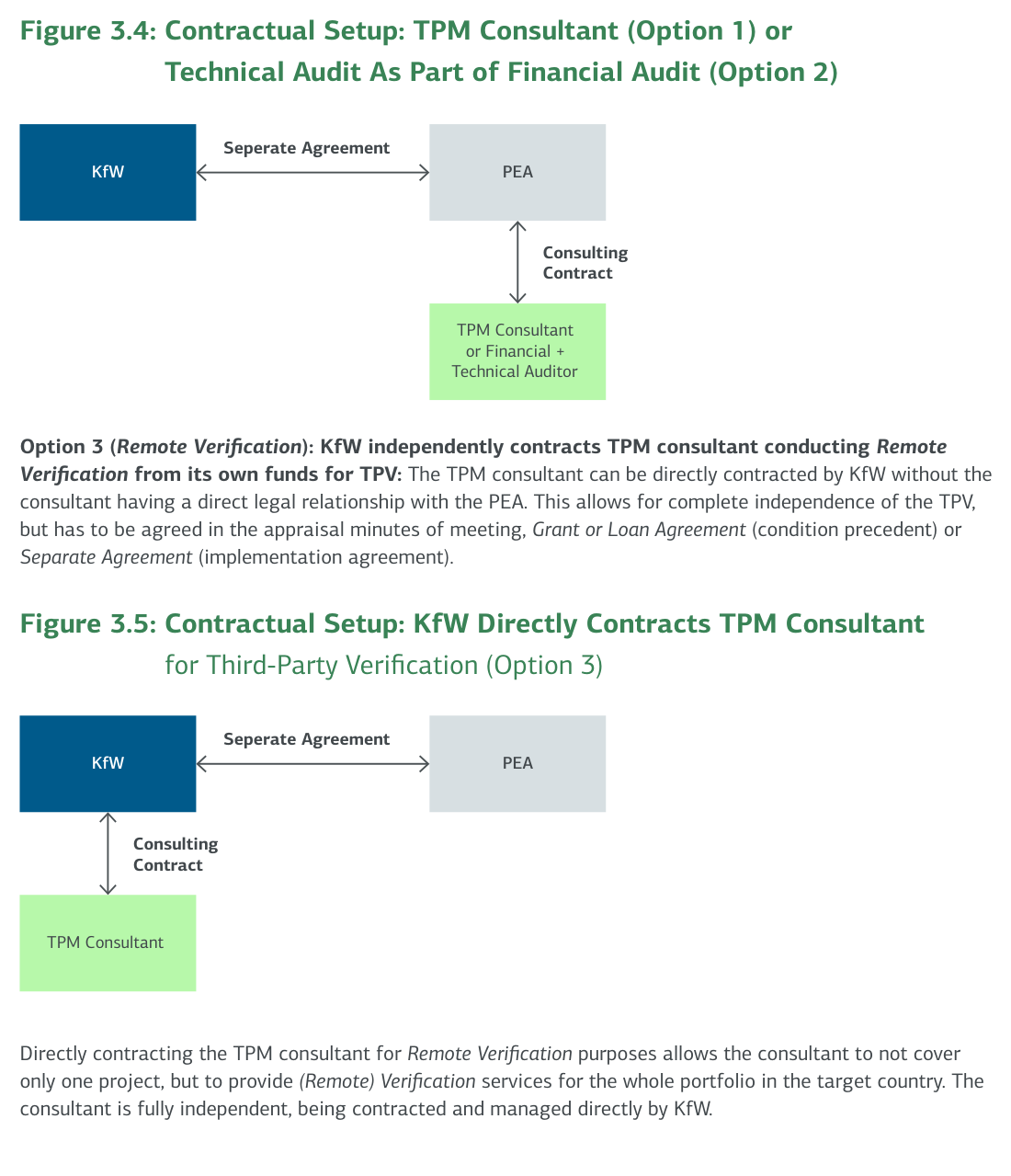
Option 3 (Remote Verification): KfW independently contracts TPM consultant conducting Remote Verification from its own funds for TPV: The TPM consultant can be directly contracted by KfW without the consultant having a direct legal relationship with the PEA. This allows for complete independence of the TPV, but has to be agreed in the appraisal minutes of meeting, Grant or Loan Agreement (condition precedent) or Separate Agreement (implementation agreement).
Figure 3.5: Contractual Setup: KfW Directly Contracts TPM Consultant for Third-Party Verification (Option 3)
Directly contracting the TPM consultant for Remote Verification purposes allows the consultant to not cover only one project, but to provide (Remote) Verification services for the whole portfolio in the target country. The consultant is fully independent, being contracted and managed directly by KfW.
3.1.5.4 Weighting of RMMV Capacity as Part of Evaluating Technical Offers
Different RMMV approaches require different levels of institutional and technical complexity, different international and local staff competencies and capacities and technical requirements for and qualifications on the part of consulting companies. To ensure the consultant has sufficient RMMV capacity it is recommended to consider the proposed RMMV design and/or relevant RMMV capacities of the bidders for Implementation Consultant/(Third-Party Monitoring/Verification consultant in the evaluation grid of the technical offer. The following changes are recommended:
- Include "RMMV approach" as a separate line under proposed concept and methods and assign a specific number of points that appropriately relate to the quality of the RMMV approach design, the complexity of the situation and how much effort RMMV requires relative to other consulting tasks.
- In case of national staff replacing international staff, increase the relative importance of the national team lead vis---vis the international team lead. Local staff may take up a considerably higher share of the points usually assigned for the qualifications of proposed international staff.
3.2 Project Implementation and Monitoring by the PEA/Consultant
Once all preparations have been made and the Grant or Loan Agreements and Separate Agreements have been concluded with the PEA, project implementation may start. The PEA is usually responsible for the project itself, managing the project, conducting tenders for suppliers and services and monitoring implementation. KfW experts oversee these steps via various RMMV approaches, tool types and data sources as needed.
If a considerable time lag has occurred between the Feasibility Study stage and the start of implementation, a renewed risk assessment that includes security risks is considered mandatory in fragile contexts.
The following recommendations are ideally to be considered as part of the Feasibility Study (> Section 3.1.2 Feasibility Study) or the project appraisal (as stated in the appraisal mission Minutes of Meeting, > Section 3.1.3 Conducting Project Appraisals remotely), and must be agreed in any case within the Separate Agreement (> Section 3.1.4.2) and/or the respective Consulting ToR (> Section 3.1.5.1 General ToR Aspects for the Implementation of an RMMV Approach). These recommendations are most relevant to projects or programs the implementation details of which were not yet fully defined in the project preparation phase-for example, specific project sites or specific activities at each site-as is frequently the case in decentralization programs, policy-based financing, multi-donor trust funds, etc.
3.2.1 Remote Investment Identification, Prioritization and Selection
Even if investment information was already collected during the preparation phase, RMMV is important for this step as there can be considerable time lags between the Feasibility Study and the start of implementation. Therefore, recent information from the project area is often necessary to establish or update the project's baseline and successfully identify, fairly prioritize, appraise, update and verify the feasibility of individual investments/measures during the inception phase of the project. 24 Various RMMV approaches can be taken for this step. The following are examples of RMMV approaches that could be utilized according to the RMMV Decision Matrix, > Section 2.5:
- Establishment of infrastructure baseline through satellite imagery: satellite imagery enables the monitoring of all infrastructure sites, and even their usage within a determined area, > Fact Sheet Earth observation (EO) via Satellites
- Analyze access to public services through GIS: GIS modeling enables to gauging access to existing public services in order to strategically select locations for new roads and socioeconomic infrastructure,
Fact Sheet Geospatial Tools/GIS
- Participatory approaches to factor in target group preferences: local staff or consultants conduct participatory approaches and photo-document the results in order to take into account the priorities of the community, > Section 2.1.1 Institutional Approach A5 and > Fact Sheet Mobile Data Collection
- Crowdsource information for planning in emergency situations: in emergency contexts, crowdsourcing of information on local population needs is obtained using the respective crowdsourcing tools, > Fact Sheet Crowdsourcing Tools
3.2.2 Investment Planning
For financing an individual project, the investment planning and impact assessment should typically be done in the project preparation phase. At the start of implementation, the focus lies on updating the initial assessments (as necessary), implementation of the E&S plans (such as ESMP, RAP etc.) and using RMMV to monitor their implementation.
For program approaches, the concrete E&S impact assessment is done for the sub projects in the implementation phase applying an environmental and social management framework that is prepared in the preparatory phase and forms the base for the appraisal. In such case, RMMV is utilized to conduct an initial survey of the selected construction site(s) and the initial Environmental and Social Impact Assessments.
After the initial surveys, monitoring and verification of the ESMP and the RAP will have to be conducted using institutional approaches, tools, or data sources. Various technical tool types can be used for this. The following are examples:
- Evaluate satellite images to identify environmental and social risks: key environmental and social risks can be identified through satellite imagery, such as current land use (resettlement) and the natural environment, such as ecosystems (environmental risks), > Fact Sheet EO via Satellites
- Use UAVs/drones to identify environmental risks: for a more detailed assessment of environmental risks, UAVs/drones can be used, > Fact Sheet Drones/UAV
- Mobile Data Collection and Crowdsourcing citizen feedback: mobile data collection and crowdsourcing tools can help participatory planning by soliciting beneficiary/target groups recommendations and feedback on individual plans and measures from a wider audience than through traditional participatory approaches, > Fact Sheets Mobile Data Collection and > Crowdsourcing Tools
3.2.3 Selection of (Construction) Contractor(s)
Projects using RMMV may face a higher risk of collusion of bidders and delays during contractor selection because projects with locations with access problems are less attractive to bidders, construction cost being more difficult to calculate. Security conditions may make it difficult for international Implementation Consultant staff and PEA staff to gather in the same place for the bid openings and evaluations, thus suitable procurement procedures have to be agreed, such as virtual pre-bid meetings, live/web-streaming of national/local openings/evaluation committees, e-tendering, and so on.
Wheresuch risk exists, to avoid receiving bids from "ghost" companies, KfW's national expert or the Implementation Consultant may visit potential bidders during the prequalification stage to verify whether they have correct information regarding staff and machine park. This process has been applied in the, > Inclusive Community Development and Decentralization project in Madagascar (PN: 33436).
Limited procurement among a list of preselected contractors may make sense to ensure contractor quality and their ability to respond to difficult security situations. If this has been identified as a useful risk mitigation measure in the respective country, it can already be specified in the ToR for the Implementation Consultant.
3.2.4 Remote Management by the PEA
One challenge in an RMMV context is keeping all relevant PEA staff informed and ensuring good communication well with stakeholders in various locations. Various RMMV approaches can be used for this step. The following are examples:
- (Remote) Management Information System for the project: a remote management information system is procured for the project. On top of georeferenced photos of different project stages, it can include further project management relevant information, such as preparatory studies, financial and technical documentation per site, and so on, > Fact Sheet R/MIS
- Data room for construction project management: a data room is a common tool in the construction industry for communication and document management, > Fact Sheet Collaboration Tools
- Building information modeling (BIM) for remote site planning and site supervision: building information modeling can also be used for preparation and management of infrastructure measures,> Fact Sheet BIM 24 Depending on the extent of project preparation, aspects from remote project preparation may also be relevant in this section. An open program, for instance, may require a needs assessment at the be-ginning of project execution.
3.2.5 Remote Site Supervision and Acceptance of Works
Site supervision and acceptance of works by the PEA/Implementation Consultant is crucial for project success, thus posing a considerable challenge in RMMV contexts. While in standard FC projects, international staff at least conduct spot checks or are even present on the construction site for the full project duration, this is usually not possible in RMMV contexts. Site visits are furthermore essential, as they form the basis for releasing additional tranches of payments to construction firms, see also, > Section 3.3.2 How to Conduct the Verification of the Use of Funds Remotely. Site supervision is also essential in terms of ESHS. In particular it has to be assessed whether the ESMP is adequately implemented, including occupational health and safety considerations, labor conditions, such as in workers' camps, environmental conditions on the construction site and community health and safety-related aspects like traffic management, and so on.
Collecting evidence on site is thus crucial to demonstrate that mitigation measures as part of the abovementioned ESMP are actually implemented.
Final output monitoring and release of guarantees usually requires additional inspections that can be executed via different RMMV approaches.
Sending local or regional project staff to do site supervision is a crucial basic element of site supervision. Various RMMV approaches can be used for this step. The following are examples:
- Simple milestone-based monitoring by local staff: Rather than paying the construction firm according to the actual amount of material used, payment is made according to the achievement of simple visual milestones (e.g., foundation built, structure completed, roofing finished), allowing monitoring by less technically qualified staff, > Section 2.1.1 Institutional approaches A2 and A3.
- Site supervision by regional engineer: a regional engineer (e.g., West African in Northern Mali) regularly visits the site. The same can be applied for a regional Environmental and Social Expert to conduct site supervision and assess whether the ESMP and further sub plans, if any, are being diligently implemented, > Section 2.1.1 Institutional approaches A2 and A3.
- Monitoring support with ESHS Tools (Apps): KfW national experts, local consultant staff and/or PEA staff can monitor ESHS items/issues via mobile phone app. The content of the check-list templates in the app needs to be prepared upfront by ESHS experts (KfW KC US can provide advice), > Fact Sheet Mobile Data Collection Tools.
- Georeferenced photos or videos: georeferenced photos or videos are taken at the construction site, for example by local engineers, to establish the baseline and then document the progress of works (e.g., reconstruction of transmission lines) and of specific elements and for monitoring of environmental and social conditions > Fact Sheet Mobile Data Collection Tools and, > Fact Sheet Cameras and > Fact Sheet Geospatial Tools.
Remote Sensing technologies can help the PEA and the consultant to triangulate information and monitor progress during those intervals when staff cannot be present:
- 24/7 webcam supervision at a construction site: webcams can be installed to continuously monitor progress on construction sites. But this may bear some data privacy issues, > Fact Sheet Cameras
- UAV/Drone recording to supervise individual construction sites: UAV/drones can be used to supervise construction sites, > Fact Sheet Drones/UAV
- Progress monitoring of infrastructure via satellite imagery: infrastructure can be identified on satellite imagery, which is why it can also be used for output monitoring, > Fact Sheet EO via Satellites.
Additional stakeholders can be engaged for site supervision, which is very useful for triangulation:
- Monitoring by local government institution: local government and community stakeholders may complement monitoring efforts by PEA and consultants, > Section 2.1.1 Institutional Approach A6
- Peer monitoring: other development partners, such as NGOs active in the region, can be asked to support monitoring, > Section 2.1.1 Institutional Approach A6
3.2.6 Feedback by Target Groups/Beneficiaries and Project-Affected Persons (PAP)
At specific points or regular intervals during project implementation, feedback from target groups, beneficiaries and PAPs is collected via participatory approaches > Section 2.1.1 Institutional Approach A5. Various RMMV approaches can be used for this step. The following are examples:
- Collection of target groups' needs/feedback/opinions/observations through participatory approaches: Rural Participatory Appraisal, Village Mapping and so on, conducted by specialized local consultants of all genders speaking the local language(s) > Annex 1 Glossary.
- Digital Grievance Redress Mechanism (e.g., > UFK Iraq, (PN: 37581): the main PEA utilizes such a mechanism so that people can anonymously disclose irregularities on project sites, > Fact Sheet Crowdsourcing Tools.
- Interactive radio shows: local radio is asked to host a show about the project where citizens can call in and anonymously voice feedback on the project, > Annex 1 Glossary. Example: Interactive radio project by Deutsche Welle in preparation for the KfW-financed > Decentralization Support Program in Togo (PN: 30205)
- Local user feedback via automated SMS questions (via Mobile Data Collection or Crowdsourcing): users are encouraged to participate in an SMS survey regarding Use, Operation and Maintenance Answers (Voice, VoIP and/or text) are recorded and analyzed (semi-)automatically, also > Decentralization Support Program in Togo (PN: 30205).
3.2.7 (Remote) Monitoring of Resettlement Activities
If physical resettlement is necessary, it can be assessed via satellites or UAV/drones whether new houses/ structures have been built and/or old structures demolished. The same can be done to assess whether economically displaced land-based affected persons or female traders have received new/substitute agricultural land or market stalls (ex-ante Detailed Measurement Survey). In addition, a Resettlement Completion Audit is also needed to demonstrate whether all provisions of the resettlement action plan have been implemented and livelihoods restored. For this, satellites and drones can be used to check what exactly has been built. A national social expert, closely supervised and trained by an international resettlement specialist, would then check whether all eligible persons were entitled and compensated as planned in the RAP.
3.2.8 Remote Monitoring of Operation and Usage
Outcome monitoring is also challenging in RMMV contexts, as it requires constant functioning and reliable data generation, even after project ending. It involves measuring usage of infrastructure and monitoring of operation and maintenance. Expectations of what is being measured differ greatly by sector, thus many different RMMV approaches may be used. Technical tools promise to generate reliable data streams at relatively little cost, thus there are many such tools of various types usable for outcome monitoring. The following are examples: Ad-hoc surveys: an individual standalone survey is conducted on project outcomes and usage among the target group, perhaps one year after operation, > Annex 1 Glossary and, > Fact Sheet Mobile Data Collection
Usage of national data/PEA's MIS or MMS: internal data of the PEA or operating utility can be used for outcome monitoring, > Fact Sheet R/MIS or > Maintenance Management Systems
Local user feedback via automated SMS questions: users are encouraged to participate in an SMS survey regarding use, operation and maintenance answers (voice and/or text) are recorded and analyzed automatically, > Fact Sheet Crowdsourcing Tools.
- Citizen monitors are individual citizens who support the monitoring of e.g., construction progress or monitor environmental and social aspects. They can either be recruited through a local committee or by selecting individuals who are actively participating through crowdsourcing tools, > Section 2.1.1 Institutional Approach A5 and > Fact Sheets on Mobile Data Collection and > Crowdsourcing Tools.
Sector-specific approaches:
Biodiversity and agriculture sector examples
- Analysis of vegetation cover through GIS: satellite imagery enables monitoring the increase of vegetation by measuring the proportion of reflected green light of an area, > Fact Sheet EO via Satellites
- Audio sensor to record wildlife or hazardous sounds: audio sensors are installed in protected areas to record sounds of wildlife and hazards through automated detection, > Fact Sheet Sensors/Smart Meters
- GIS system to supervise marine reserves: a system where all vessels have to register and install an on-board monitoring system prior to entering the marine reserves, > Fact Sheet Geospatial Tools
- Measurement of water flow in irrigation canals or in dewatered reaches of hydropower projects to ensure environmental flow: sensors are placed in irrigation channels or below the weir in case of hydropower projects to measure flow rate, water level and water quality, > Fact Sheet Sensors/Smart Meters.
- Counting of wildlife via manned airplanes: certain wildlife species are counted via airplane to evaluate the success of protection measures, > Fact Sheet Drones/UAV.
Traffic/population movement sector examples
- Inductive-loop traffic detectors: an insulated, electrically conducting loop is installed in the pavement to measure traffic, > Fact Sheet Sensors/Smart Meters.
- Evaluate population movement through mobile phone data: population movement is modeled through an evaluation of mobile phone data received from a mobile network operator, > Fact Sheet Data Sources (big data).
Utilities (water and electricity) sector examples
- Smart meter: water or electricity meters that not only record usage but also directly report the information to the utility firm, > Fact Sheet Sensors/Smart Meters.
Regional economic development sector examples
- Estimate regional economic activity through mobile phone big data: analyzing big data automatically generated by mobile phones enables estimating of economic activity within a given region,
Fact Sheet Data Sources (big data).
3.2.9 Remote Monitoring of Maintenance
Various RMMV approaches can be used for this phase in the project cycle. The following are examples:
- UAV/drone flight for maintenance of infrastructure: UAVs/drones are equipped with special cameras or sensors that can verify the functionality of certain infrastructures (roads - potholes, power cable - flowing electrical current), > Fact Sheet Drones/UAV.
- Infrastructure maintenance management software: an infrastructure maintenance management software can be procured to support the operator in managing his infrastructure assets, > Fact Sheet Maintenance Management Systems.
- Satellite imagery to monitor condition of large infrastructure: satellite imagery can be used to monitor the condition of large infrastructure and inform maintenance decisions, > Fact Sheet EO via Satellites.
3.2.10 Capacity Development for RMMV
Implementing RMMV approaches, especially participatory approaches, and specific technical tools in most cases requires greater capacity in terms of national and local staff. Training and equipping target group members, representatives and/or extension workers should equally be considered depending on the approach(es) and tool type(s) envisioned. Staff need to understand monitoring procedures and the technology involved as well as participatory approaches, local culture and local languages. Even if staff are experts in participatory approaches, they may need training in how to use specific tools or methods. On the other hand, technical expert staff (engineers/technology experts) may require additional training to ensure quality monitoring and on how to handle or use specific tool types or software.
Moreover, RMMV can serve as an entry point for developing digital capacities and competencies across all project stakeholders, with long-term positive impacts.
Various RMMV approaches and tool types can be used for developing local capacities remotely.
The following are examples:
- Support to monitoring system by Implementation Consultant: The Implementation Consultant supports the PEA to develop an adequate M&E system and verifies the correctness of these data.
- Use massive open online courses (MOOCS) to build RMMV capacity: MOOCs are online available courses that can be easily accessed by staff and other stakeholders for training on general M&E topics and on the relevant RMMV approaches and/or tool types, such as on using specific software. For project-specific user trainings however, tailored training solutions are often necessary, see below > Fact Sheet eLearning Tools.
- Virtual training: Specific project-related training needs can be provided via virtual training seminars, developed by the international project Implementation Consultant, for example, and administered to the national and local staff, > Fact Sheet eLearning Tools. KfW also offers training seminars on RMMV for its national and international staff, partners and consultants.
- A tailored capacity development concept must be developed and implemented for each project by the Implementation Consultant, including a blended learning concept with online training seminars as well as face-to-face training if possible and a comprehensive concept on how interaction between local, national and international staff is to be conducted, including backstopping and how information management is implemented. This should be explicitly mentioned in the ToR for the Implementation Consultant.
3.3 Remote Verification of Project Progress by KfW
If due to the security situation or other specific circumstances of the project a physical progress review is not possible or cannot be carried out by KfW itself, wholly or in part, this must already be taken into account in the planning phase of the project if such risk has been identified at that stage. In such case, a Remote Progress Review has to be conducted using the institutional approaches, technical tools and data sources per > Section 2, including particularly > Section 2.5 RMMV Decision Matrix as well as the Sections below.
In its first regular project progress report, KfW's client is informed about the chosen RMMV approach and related RMMV risks.
It is important to note that even if KfW HQ staff have direct access to the project's monitoring/management information systems, > Fact Sheet (Remote) Management Information Systems, it is not feasible in terms of cost and effort for financing institutions such as KfW to continuously review all information available in such systems. To mitigate these risks, the Remote Verification responsibilities of KfW staff need to be clearly defined, for example by establishing clear procedures for when and how system data are reviewed by KfW, such as in "remote or virtual project progress review missions." Such procedures together with the planned RMMV approach should be documented in the planning document for verifying use of funds.
3.3.1 How to Conduct a Remote Progress Review
Progress and final reviews/inspections are necessary steps in the FC project cycle to verify the project implementation vis---vis the requirements set forth for the Project Executing Agency (PEA). These are typically carried out by the KfW PM and/or the technical expert. A virtual or remote progress review is a progress review that needs to be conducted outside of the target location or country. General progress and final review procedures as defined by KfW are detailed in the KfW internal standard operating procedures.
It cannot be over-emphasized that virtual reviews can never adequately replace a physical, in-person review visit, as with the former it is difficult to gain access to information that enables impartial and independent assessment. Itis thus advised to first explore all options for obtaining information first-hand. Has the target site been visited by KfW staff before? Is there a local resource (e.g., local consultant) who could be utilized for independent observation, discussion and analysis? This information can then be supplemented by remote or virtual data sources and data collection tools.
The entire process of preparation, conducting the virtual review mission and follow-up activities takes on average 2-3 months to complete. A virtual review or inspection mission can range from 1 to 10 working days in lenght depending on the complexity of the project and the number of issues involved. The steps in conducting a virtual/remote progress review and final review along with key considerations are next summarized below.
3.3.1.1 Preparation of Remote Project Progress Review
Thorough preparation is required for an efficient progress review or final review mission. This is an opportunity to identify key point of contacts, priority issues and limitations, and make appropriate arrangements prior to conducting the review mission. It is important to budget sufficient time to preparations for a virtual or remote review.
The more information we can collect the easier it will be for us to plan. Explore various options and sources of information, including Open Data (> Section 2.2.3. The Use of Data Sources), existing reports, direct consultations with the KfW country office, PEA, government entities consultants, NGOs, research institutions, other partners, and other such options. Where possible, explore whether other international lenders or donors in the country or near the target site could also provide useful information.
Key aspects to consider during the preparation phase include, but are not limited to, the following:
Table 3.3: Checklist on How to Prepare a Remote Project Progress Review
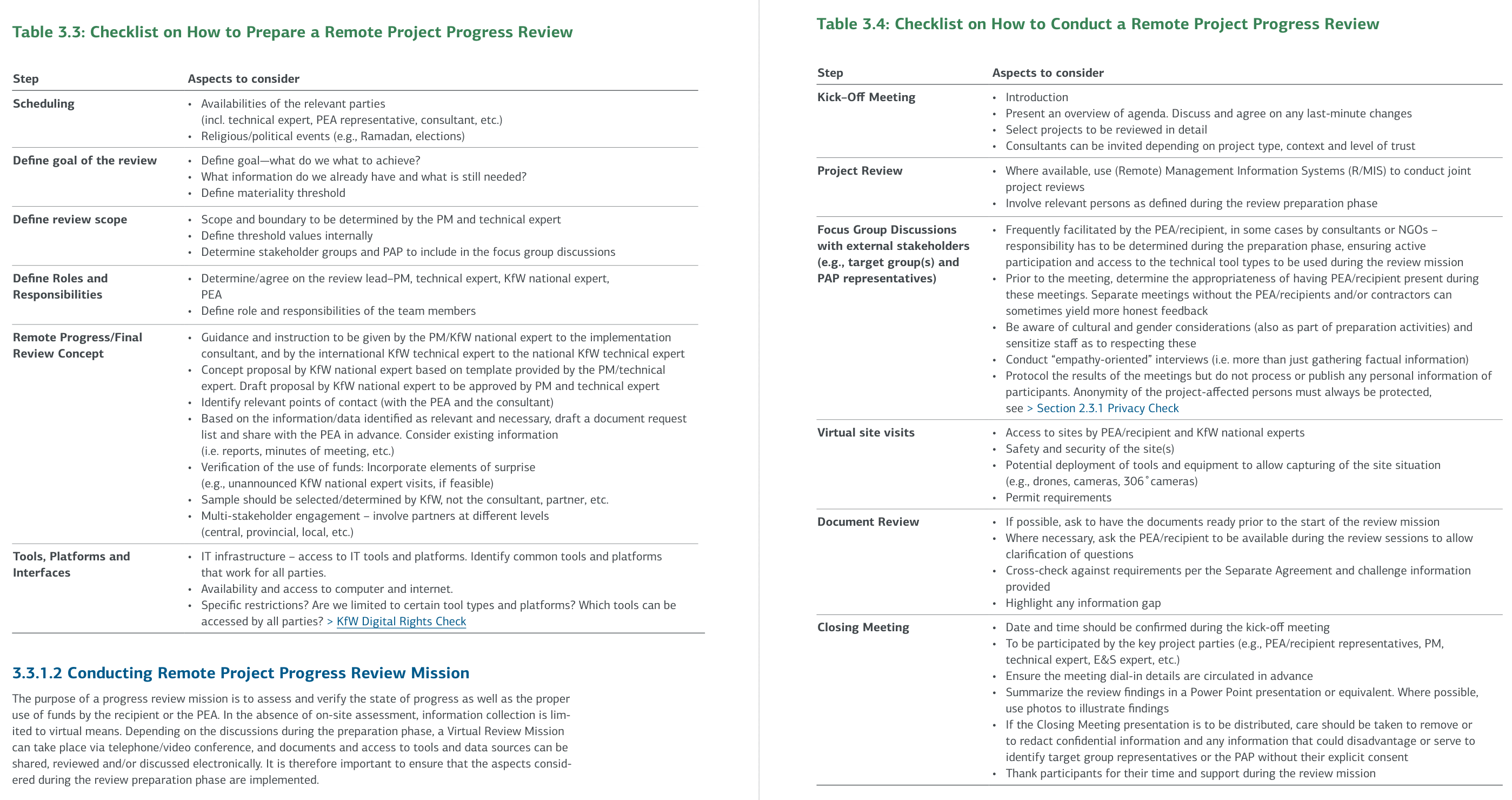
Although key aspects have been agreed with the various stakeholders during the review preparation phase, it is nevertheless recommended to distribute a reminder (e.g., per email) at least one week prior to start of the planned review mission. The agenda of the virtual review mission should also be circulated. The purpose of the reminder is to ensure the participation of key stakeholders and the timely provision of information, and allow time to make adjustments to the agenda if needed. Also, check whether the relevant technical tool types (e.g., Collaboration Tools and R/MIS) are accessible to all review participants.
At least three days prior to the scheduled review mission, check if the meeting dial-in information has been distributed to all required participants. Where necessary, follow up with the key points of contact (e.g., PEA, consultant) if no response to the reminder email has been received.
The aspects to consider in a Virtual Review Mission are very much similar to those of a conventional review mission. These are summarized as follows:
Table 3.4: Checklist on How to Conduct a Remote Project Progress Review
Step Aspects to consider Scheduling
- Availabilities of the relevant parties (incl. technical expert, PEA representative, consultant, etc.)
- Religious/political events (e.g., Ramadan, elections)
Define goal of the review
- Define goal-what do we what to achieve?
- What information do we already have and what is still needed?
- Define materiality threshold
Step Aspects to consider
Kick-Off Meeting
- Introduction
- Present an overview of agenda. Discuss and agree on any last-minute changes
- Select projects to be reviewed in detail
- Consultants can be invited depending on project type, context and level of trust
Project Review
- Where available, use (Remote) Management Information Systems (R/MIS) to conduct joint project reviews
- Involve relevant persons as defined during the review preparation phase
Define review scope
- Scope and boundary to be determined by the PM and technical expert
- Define threshold values internally
- Determine stakeholder groups and PAP to include in the focus group discussions
Focus Group Discussions with external stakeholders (e.g., target group(s) and
- Frequently facilitated by the PEA/recipient, in some cases by consultants or NGOs - responsibility has to be determined during the preparation phase, ensuring active participation and access to the technical tool types to be used during the review mission
Define Roles and Responsibilities
Remote Progress/Final Review Concept
- Determine/agree on the review lead-PM, technical expert, KfW national expert, PEA
- Define role and responsibilities of the team members
- Guidance and instruction to be given by the PM/KfW national expert to the implementation consultant, and by the international KfW technical expert to the national KfW technical expert
- Concept proposal by KfW national expert based on template provided by the PM/technical expert. Draft proposal by KfW national expert to be approved by PM and technical expert
- Identify relevant points of contact (with the PEA and the consultant)
- Based on the information/data identified as relevant and necessary, draft a document request PAP representatives)
- Prior to the meeting, determine the appropriateness of having PEA/recipient present during these meetings. Separate meetings without the PEA/recipients and/or contractors can sometimes yield more honest feedback
- Be aware of cultural and gender considerations (also as part of preparation activities) and sensitize staff as to respecting these
- Conduct "empathy-oriented" interviews (i.e. more than just gathering factual information)
- Protocol the results of the meetings but do not process or publish any personal information of participants. Anonymity of the project-affected persons must always be protected, see > Section 2.3.1 Privacy Check
Tools, Platforms and Interfaces
list and share with the PEA in advance. Consider existing information (i.e. reports, minutes of meeting, etc.)
- Verification of the use of funds: Incorporate elements of surprise (e.g., unannounced KfW national expert visits, if feasible)
- Sample should be selected/determined by KfW, not the consultant, partner, etc.
- Multi-stakeholder engagement - involve partners at different levels (central, provincial, local, etc.)
- IT infrastructure - access to IT tools and platforms. Identify common tools and platforms that work for all parties.
- Availability and access to computer and internet.
- Specific restrictions? Are we limited to certain tool types and platforms? Which tools can be accessed by all parties? > KfW Digital Rights Check
Virtual site visits
- Access to sites by PEA/recipient and KfW national experts
- Safety and security of the site(s)
- Potential deployment of tools and equipment to allow capturing of the site situation (e.g., drones, cameras, 306?cameras)
- Permit requirements
Document Review
- If possible, ask to have the documents ready prior to the start of the review mission
- Where necessary, ask the PEA/recipient to be available during the review sessions to allow clarification of questions
- Cross-check against requirements per the Separate Agreement and challenge information provided
- Highlight any information gap
Closing Meeting
- Date and time should be confirmed during the kick-off meeting
- To be participated by the key project parties (e.g., PEA/recipient representatives, PM, technical expert, E&S expert, etc.)
3.3.1.2 Conducting Remote Project Progress Review Mission
The purpose of a progress review mission is to assess and verify the state of progress as well as the proper use of funds by the recipient or the PEA. In the absence of on-site assessment, information collection is limited to virtual means. Depending on the discussions during the preparation phase, a Virtual Review Mission can take place via telephone/video conference, and documents and access to tools and data sources can be shared, reviewed and/or discussed electronically. It is therefore important to ensure that the aspects considered during the review preparation phase are implemented.
- Ensure the meeting dial-in details are circulated in advance
- Summarize the review findings in a Power Point presentation or equivalent. Where possible, use photos to illustrate findings
- If the Closing Meeting presentation is to be distributed, care should be taken to remove or to redact confidential information and any information that could disadvantage or serve to identify target group representatives or the PAP without their explicit consent
- Thank participants for their time and support during the review mission
3.3.1.3 Follow-Up Activities
Following the review mission, hold a debriefing meeting with the team members within one week of the Closing Meeting to a) reflect on the review mission process, b) discuss challenges and lessons learned, and c) set the timeline for completing the Monitoring Report and define roles and responsibilities. Summarize the review findings in a Monitoring Report and submit to KfW Management for review. Establish a Corrective Action Plan (CAP) based on the findings of the review mission. The CAP should include a concise description of the findings and the corresponding corrective actions, and define individuals/functions responsible for implementing corrective actions. Set timeline for completing the corrective actions. Share the CAP with the PEA/recipient and schedule a call to explain the findings and the corrective actions. Obtain PEA/ recipient's acceptance to CAP in writing. Use CAP as the basis for follow-up and to track progress in the next progress review.
3.3.2 How to Conduct the Verification of Use of Funds Remotely
If due to the security situation or other project-specific circumstances physical supervision of the use of the funds is not possible or cannot be carried out by KfW itself, wholly or in part, this must already be taken into account in the planning phase of the project if such risk has been identified in the planning stage. The particulars must be justified and alternative procedures selected as part of planning for auditing of the use of funds, > Section 2, in particular > Section 2.5 RMMV Decision Matrix as well as > Section 3.3.1.
If an on-site audit is not not possible, wholly or in part, even if only temporarily a. this must be documented and justified b. a procedure should be chosen that adequately implements requirements for auditing of the use of funds, > Section 2.5 RMMV Decision Matrix c. in case of budget funds and development loans, the respective client, e.g., the Federal Ministry for Economic Cooperation and Development or the ministry that issued the promotional mandate, must be informed.
If adequate verification procedures are not available either, the respective client of KfW for the project must be informed that KfW can only fulfil its monitoring obligations to a limited extent.
In the case of highly fragile contexts, the Implementation Consultant is often charged with managing project funds on behalf of the recipient (> Section 2.1.1 Institutional Approach A3, sometimes also > Section 2.1.1 Institutional Approach A2). In such contexts, the Implementation Consultant should be requested to keep the original procurement and accounting documents in a safe location, e.g., at the consultant's HQ. Remote Verification of the use of funds can then be conducted by KfW staff at that location.
If international transfer of the original documents is not feasible (although the security situation allows such), it is recommended to plan for regular accounting-based audits of use of funds by qualified national auditor firms on-site or in-country during project implementation. You may also consider involving KfW national experts to a greater degree in this regard.
3.4 End of Project
An FC project usually ends once all of its planned activities have been either executed or permanently suspended. Any works completed during the project implementation phase are subject to a provisional commissioning/acceptance procedure, followed by the final commissioning/acceptance procedure after elapse of the warranty/guarantee period (i.e. 12 months in most cases). KfW performs a final review, ideally between provisional and final commissioning/acceptance,. In many cases, an ex-post evaluation of the project impact is conducted after a predefined period following final review.
3.4.1 Commissioning/Acceptance of Works
Generally, the provisional and final commissioning/acceptance of works are conducted by the PEA and/or the Implementation Consultant as part of their (Remote) Monitoring activities. If they face challenges regarding the accessing of project sites, they may also resort using alternative institutional approaches and technical tools, although this step is very difficult to conduct remotely: a highly qualified technical expert usually needs to touch the items and perform a number of tests. Virtual site visits, > Section 3.3.1.2 Conducting Remote Project Progress Review Mission, may substitute for the required checks in part, but are usually insufficient for a full performance test. If physical commissioning/acceptance of works on site is not possible, this problem needs to be communicated to KfW and solutions be agreed among the main project parties (including adapting the time schedule in case of temporary access problems). Also, the respective client of KfW, e.g., the Federal Ministry for Economic Cooperation and Development (BMZ) or the ministry that issued the promotional mandate for the project, must be informed by KfW.
3.4.2 Remote Final Project Review by KfW
Regarding the preparation and implementation of the remote final review, the same procedures apply as for a remote project appraisal and auditing of use of funds, > Section 3.1.3 Conducting Project Appraisals Remotely and > Section 3.3.2 How to Conduct the Verification of Use of Funds Remotely.
The final review will generally take place:
- once the funds have been disbursed or more than 90% of the funds have been disbursed
- after provisional acceptance of the project equipment or after readiness for operation has been achieved
- in the presence of the Implementation Consultant where possible, well in advance of expiry of the warranty/ guarantee period.
The final review as a rule involves an on-site inspection. This can only be waived under exceptional circumstances where a rationale is given. In such cases, the necessary data (especially on use of funds) should be gathered by other means and evaluated:
If due to the security situation or other project-specific circumstances a physical final project review or inspection is not possible or cannot be carried out by KfW itself, wholly or in part, this must already be taken into account in the planning or implementation stages of the project, depending on the stage in which such risk has been identified. In such case, a Remote Final Project Review has to be conducted using the institutional approaches, technical tools and data sources per > Section 2, including particularly > Section 2.5 RMMV Decision Matrix. The same recommendations stated in > Section 3.3 Remote Verification of Project Progress by KfW above apply.
When using the RMMV Decision Matrix however, the importance of the information needs regarding Outcome and Impact Monitoring increases considerably and the RMMV approach needs to be adapted accordingly. Usually, the collection of feedback from target groups and PAP on the projects outcomes and impacts observed so far is part of the final review, which needs to be conducted in a safe manner for all participating parties.
Also, during the remote final project review the necessary data for ex-post evaluation of the project should be recorded and safely transferred to KfW.
If the project uses an R/MIS, we highly recommend including in the ToR of the PEA and/or Implementation Consultant in charge of managing the R/MIS the assurance of keeping the R/MIS accessible to KfW until remote final review by KfW. It is also advisable to include an Erasure Policy (> Section 2.3.1 Privacy Check) as well as auto-lock and data destruction safeguards in fragile contexts for technical tools and data sources that contain personal or other sensitive data. We also recommend consulting the > KfW Digital Rights Check.
The remote final project review concludes with jointly drafting and signing of the Minutes of Meeting with the PEA at its end and a back-to-office report including the final review concept stating the RMMV approach chosen and the reason(s) for having to conduct the final review remotely.
3.4.3 Ex-post Evaluation by KfW
RMMV is important to be considered in this step of the project cycle because remote ex post evaluations (EPE) can rely on many of the approaches that were discussed previously. EPEs usually take place more than two years after the project implementation ends, thus the important question is how and under which conditions the above-mentioned tool types can be used for ex-post evaluations.
Data visualizations and analyses (data elements) help close information gaps, triangulate available data (e.g., from the project executing agency or consultant) and crystallize and illustrate central statements from larger amounts of data. This is important for targeting a selection of intervention sites and target groups appropriate to the project objectives during project preparation, appraisal, implementation, monitoring and evaluation.
The Evaluation Department of KfW (FC-E) is always looking for new ways to conduct evaluations of projects that are as data and evidence-based as possible. In some cases, data elements are used to triangulate information from on-site evaluations or identify particularly relevant project sites to be looked at more closely in an evaluation visit. In the context of the COVID-19 pandemic, data elements are becoming increasingly important for conducting evidence-based evaluations remotely without travel.
In March 2020, FC-E published a brief guide on remote evaluation techniques. Nevertheless, remote data elements can never fully replace project visits, as some information can only be obtained through interviews and site visits.
FC-E considers whether a local evaluator should be used and/or secondary data can provide insights on a case-by-case basis. It must be noted that statistical methods can only be used to measure the effectiveness of the FC-E intervention in a few cases. Still, descriptive information and visualizations can be helpful, e.g., for assessing the targeting of project sites or analyzing developments between project appraisal and evaluation. However, observed changes are not necessarily causally attributable to the project; rigorous impact evaluation methods are particularly suitable for this purpose. These allow evaluators to look not only at the development of indicators over time but also at in comparison to the development thereof for similar sites/target groups (control group), and to control for other factors not influenced by the project.
In > Section 4.2, examples of data elements that FC-E has previously used in ex-post evaluations and have been prepared remotely are presented.